

Welcome to another DeFi Markets Update—your no-nonsense briefing on the cryptobanking plumbing and market pulse.
Credit Spreads Show Signs of a Maturing Market
We examine rates across Steakhouse Prime USDC and High Yield on Base and Ethereum to understand what is actually driving the extra yield between them. Since May, rates have been much more stable, after a pretty volatile start to the year with exploits and shifting borrow demand.
Looking at the credit spread, defined as the APY difference between HY and Prime, the two series were moving apart for the majority of the period. This suggests that the difference between them was more likely coming from unexpected changes in borrowing demand, liquidity or market composition, such as the onboarding of new collateral like cbXRP or events like the three exploits we experienced in spring: Resolv, Kelp and Drift.
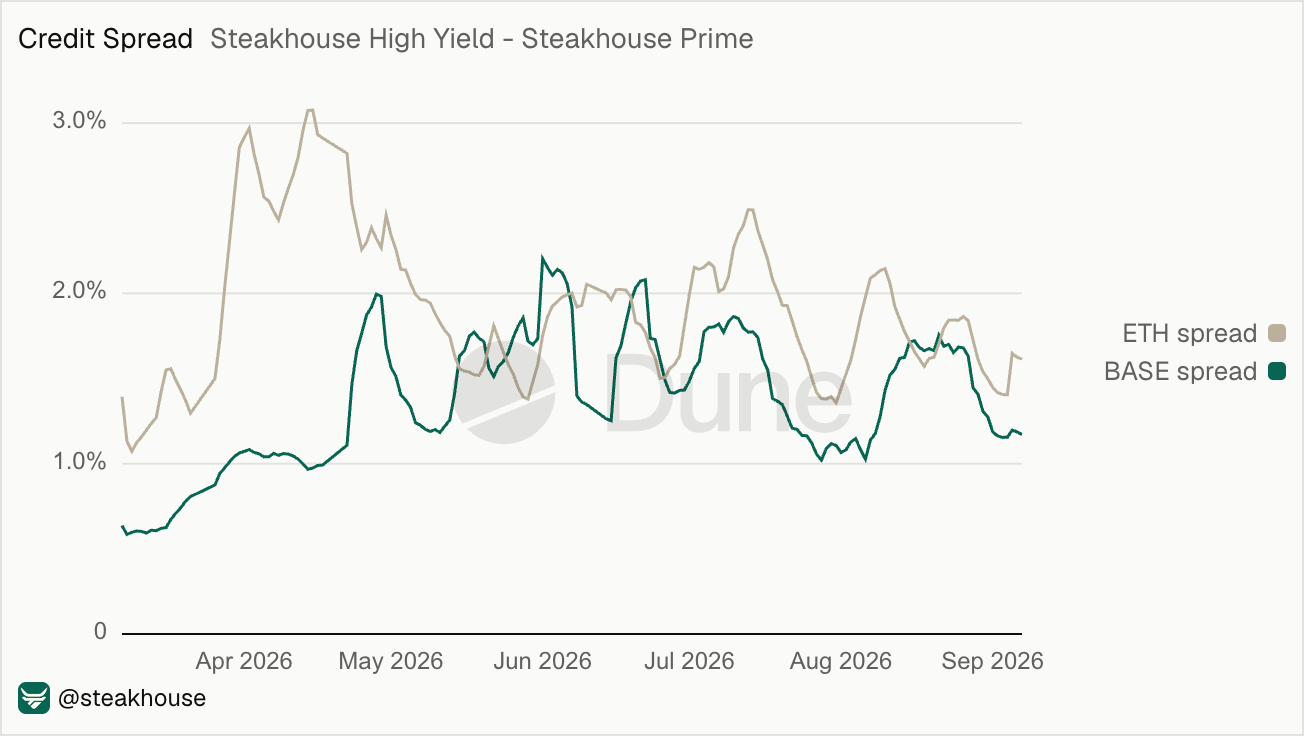
More recently, the two series have started converging and following a similar pattern. During July and halfway to August, they have been around 0.87 correlated, showing that the extra yield in HY over Prime has been priced increasingly similarly across both chains.
The two moving in sync suggests that investors are pricing and accepting riskier strategies more consistently across chains, creating a more homogeneous risk segment and making the credit premium easier to isolate as a distinct risk factor.
To conclude, this is encouraging because it points to a more mature market with less outside noise. As rates become easier to separate into repeatable factors like credit, or even chain, stablecoin and platform risk, DeFi becomes more comparable to TradFi, where this kind of factor decomposition is already standard.
Trezor Extends Steakhouse Earn From USDC & USDT to ETH
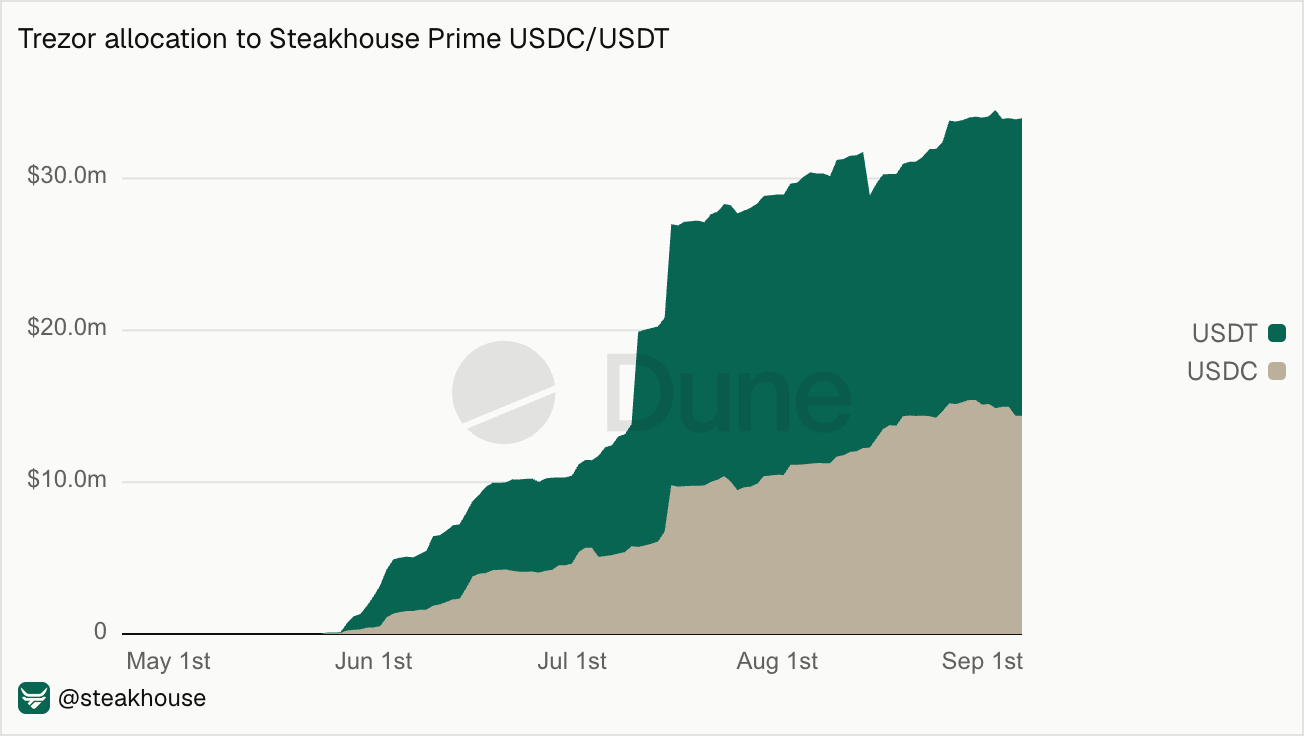
Trezor has added Steakhouse Prime ETH to Trezor Suite, expanding the Earn setup that started with Prime USDC and USDT in May on Ethereum Mainnet [read more here]. Users can now access the ETH vault directly from the same wallet interface, adding a lending option alongside Trezor’s existing ETH staking product.
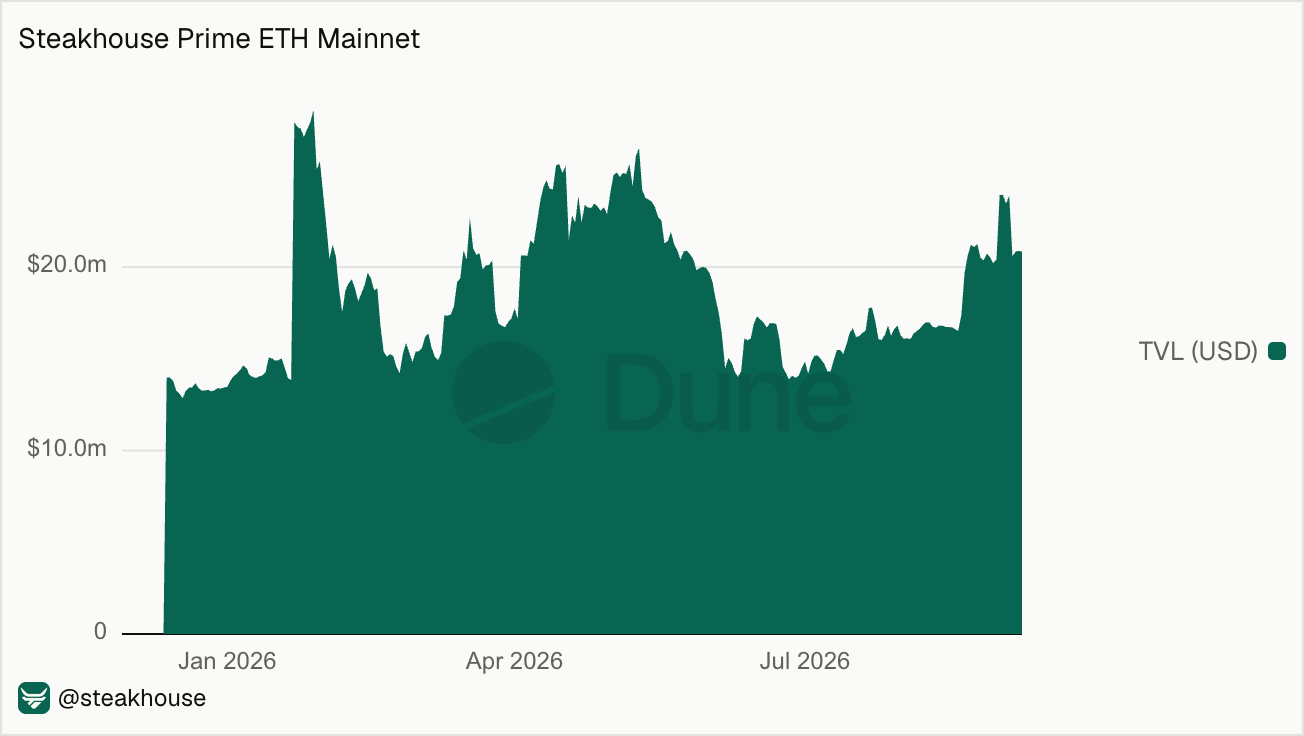
Deposited ETH is automatically wrapped to WETH and routed into our Steakhouse Prime ETH, where it earns variable lending yield from borrowers while staking earns its return from Ethereum validator rewards. The vault currently has around $20m deposited.
The earlier Trezor rollout has already brought around $33.5m combined into our USDC and USDT Prime vaults. The ETH launch extends the same setup to another major asset across Trezor’s 2m+ users.
Midas Fasanara mF-ONE Expands to Solana as solmF-ONE
Midas has expanded Fasanara Capital’s F-ONE strategy to Solana with solmF-ONE, following the existing mF-ONE market on Ethereum. The asset is now live as collateral on Kamino.

The original mF-ONE on Ethereum currently has around $65m in TVL, while the new Solana issuance launched only last week and has crossed $50k in TVL.
Steakhouse onboarded the asset across our USDC High Yield and USDG High Yield vaults on Kamino. The vaults can now allocate liquidity to this new borrower segment as demand develops.
The solmF-ONE Kamino market currently has around $1.61m of lending liquidity supplied, made up of roughly $1.29m USDG and $315k USDC. Moreover, the market offers a wide yield spread, with solmF-ONE earning 10% while USDC and USDG can be borrowed for 2.50%.

F-ONE earns yield from Fasanara-managed private credit, mainly short-duration receivables financing, alongside market-neutral digital-asset strategies. Fasanara manages more than $5.5bn in assets.
On Solana, solmF-ONE uses three liquidity layers which are instant liquidity, intermediate liquidity management and the core F-ONE allocation. This helps support faster redemptions around slower-settling private-credit assets.