

Steakhouse is launching the Steakhouse USD Machine on Makina, a DeFi execution engine for onchain strategies. Makina’s infrastructure allows Machines to allocate across protocols, chains and asset types with strong cryptographic guarantees. We value the product on the back of it offering trustless NAV accounting, atomic execution and strong guardrails around operator permissions.
Steakhouse USD Machine is our first deployment on Makina, designed to offer automated yield aggregation across chains through a single deposit. In the below post we cover what Makina unlocks as infrastructure, how the USD Machine will work at launch and how to get started.
What Makina brings
At the core of Makina is MakinaVM, a flexible execution environment that replaces traditional smart contract adapters with lightweight Instruction sets, reducing the integration overhead for each new protocol. This is what makes Makina a DeFi execution engine rather than a single-purpose vault wrapper, like our Box vaults.
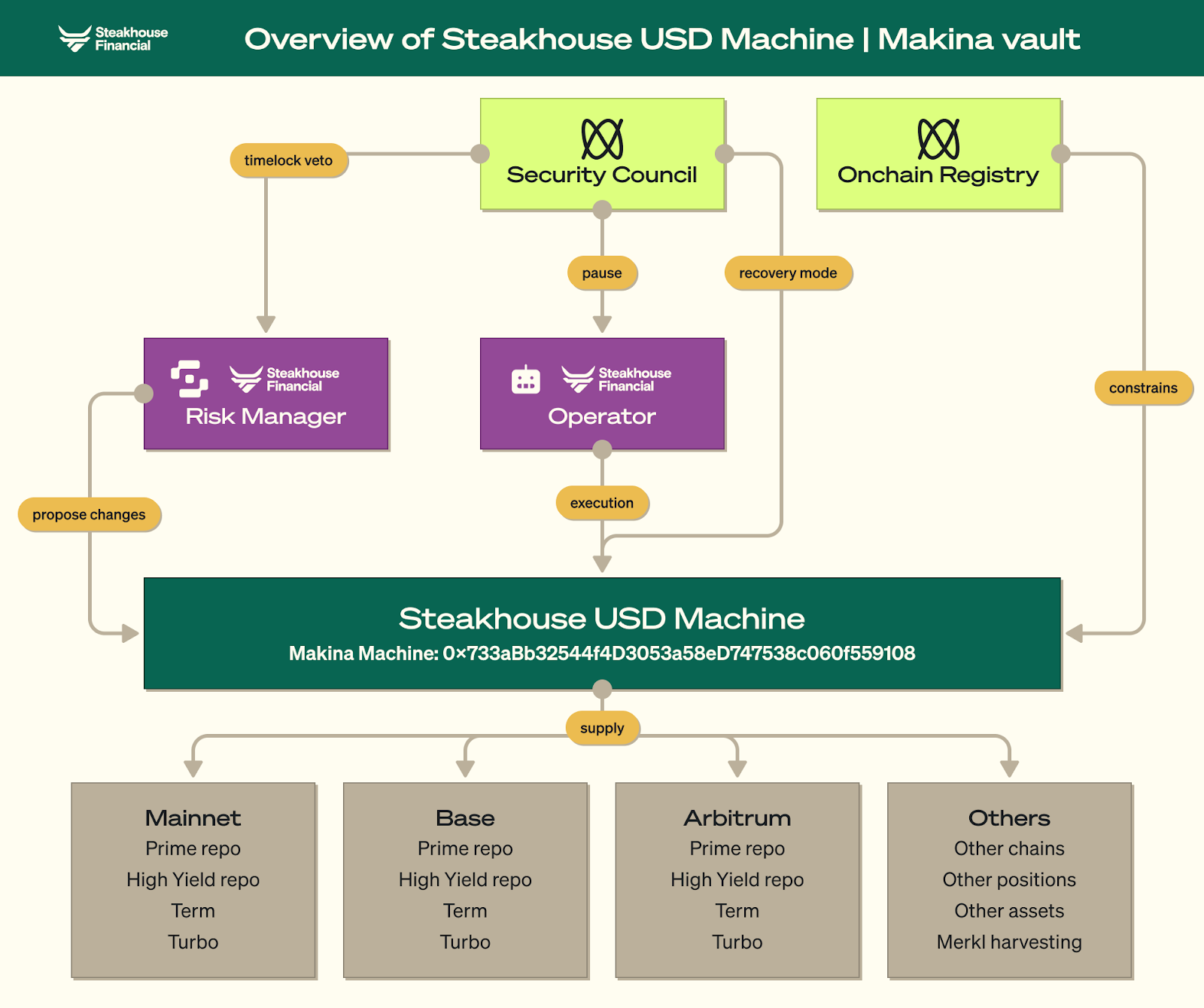
Each Machine operates through Calibers, which are chain-local execution engines deployed on any supported chain. A Caliber holds funds, accounts for local positions, and interacts with protocols on that chain. All position values are relayed back to the Machine, which computes an aggregated NAV onchain. The Machine Token price reflects actual NAV, in a verified and transparent way. Crucially, Steakhouse as an operator has no influence on how the NAV is struck.
Merkle tree permissions. Each Machine’s approved actions are encoded in a Merkle tree structure. A Merkle tree is a cryptographic data structure that lets anyone verify whether a specific action is approved without needing to read the entire configuration. For allocators, the practical implication is legibility: you can audit exactly what the Operator is permitted to do, and that permission set is enforced onchain. The blueprints are furthermore readable in Makina’s GitHub repo in a human and agent-readable YAML format.
Governance: Security Council, Risk Manager, and Root Guardians. Three governance roles sit above the Operator. The Risk Manager can adjust risk limits and propose configuration changes, which go through a timelock and can be vetoed by the Security Council. The Security Council can veto timelocked changes and trigger Recovery Mode, which pauses normal Machine operations. Root Guardians hold veto power over Merkle Root updates, which define the full scope of what the Operator is permitted to do. Together, these roles create layered oversight where no single party has unchecked authority.
Oracle Registry. All asset pricing runs through Chainlink oracles registered in Makina’s Oracle Registry. This provides standardised, externally sourced pricing across every asset the Machine interacts with.
Cross-chain capability. Makina’s architecture supports operations across multiple chains from a single Machine through its Caliber system. For strategies that benefit from accessing liquidity or yield opportunities on different networks, this removes the need for separate vaults per chain or manual bridging.
How the USD Machine works
Target: Aim to offer noncustodial stablecoins yields equal to or greater than Mainnet High Yield repo by
Allocating to dislocated repo opportunities across chains
Allocating within constraints to less liquid opportunities in Term and Turbo
Allocating opportunistically to individual situations (point farms, PT tokens, etc)
Steakhouse operates the Machine through Makina’s Operator model, executing yield strategies within a permission set we define and publish onchain. Every action available to the Operator is explicitly encoded in the Merkle tree configuration. If an action is not in the tree, it cannot be executed.
The Machine aims for a high degree of automation, nondiscretion and noncustodiality, leveraging our curator tooling and experience.
Considerations
Steakhouse Financial is a vault-agnostic curator. Every vault infrastructure involves tradeoffs. Naming them is part of how we operate.
Withdrawal mechanics. Makina uses an asynchronous withdrawal queue. When you request a withdrawal, it enters a first-in, first-out (FIFO) queue that the Operator settles. Unlike lending protocols where depositors can trigger instant redemption, on Makina you cannot bypass the queue. The queue adds a time dependency that depositors should factor into their liquidity planning. The redemption queue is settled through an automated mechanism that pulls out of a designated liquidity adapter to minimize the queue time.
Broader action set, scoped by design. Makina’s modular architecture allows a wider range of operations than lending-only protocols. Every action available to the Operator is constrained through Makina’s Merkle tree permissioning system, where the full set of approved instructions is publicly available in an open repository and verifiable against the root stored onchain. Steakhouse operates within this framework under layered governance oversight, including the Risk Manager, Security Council, and Root Guardians, and maintains transparent reporting on all Machine activity. We treat transparency as a baseline requirement. Depositors should understand that a broader operating environment is inherently different from a narrow one.
Oracle dependency. The Machine relies on oracle infrastructure for asset pricing. Oracle downtime, delayed price updates, or feed inaccuracies may affect Machine operations. Any external dependency introduces risk that depositors should account for.
Operational track record. Steakhouse has curated vaults across DeFi since January 2024. Our operational history on Makina is shorter. We apply the same curation standards and risk frameworks, but the track record on this specific infrastructure is new. That context matters for allocators sizing their positions.
Prior security incident. Makina depositors experienced an exploit in January 2026 involving a secondary market liquidity pool. The exploit did not occur on Makina’s core execution infrastructure, but in its secondary liquidity markets. The robustness of the protocol to this situation - namely, the protocol itself was not exploited - as well as the team’s subsequent response and contract-level security hardening, was a factor in our diligence and met the standard we would expect from a professional team managing critical infrastructure. The protocol upgrades implemented after the incident have strengthened the safeguards around the vectors that were exploited, which narrowly required specific conditions to be true (exposure within the Machine to liquidity pools, secondary trading of the Machine tokens and atomic NAV updates at the same time).
Steakhouse’s use of Makina is scoped to cross-chain yield aggregation across our vault portfolio, and does not involve using Machine Tokens as collateral or relying on secondary market liquidity pools, which were the vectors involved in the incident - even if a similar situation has been rendered impossible in the future following the protocol hardening.
How to deposit
Depositing into the USD Machine is straightforward:
Navigate to the Makina app
Locate the Steakhouse USD Machine
Connect your wallet
Select your deposit amount and confirm the transaction (Ethereum)
Receive your Machine Tokens (MTs) representing your aggregated position
For full documentation on Machine mechanics, withdrawal processes, and fee structures, see Makina docs and Steakhouse docs.
Rewards
The USD Machine offers multiple layers of return for depositors.
Native yield. The Machine generates yield through Steakhouse-curated USD strategies aggregated on Makina. This is the baseline return from the underlying strategy.
Makina Season 2. The USD Machine is part of Makina’s Season 2 rewards campaign. Holders of the Steakhouse USD Machine token will get a 1.0x point multiplier.
Points accumulated during Season 2 convert to MAK tokens at the Token Generation Event (TGE). For the latest on multiplier rates and Season 2 mechanics, check Makina Season 2 page.
Steakhouse Financial curates onchain yield strategies across multiple vault infrastructures. For more on how we evaluate infrastructure and manage risk, visit steakhouse.financial.
This content is for informational purposes only and does not constitute financial advice. DeFi protocols carry inherent risks including smart contract risk, oracle risk, and liquidity risk. Always conduct your own research before depositing.
Disclaimers → steakhouse.financial/disclaimers