

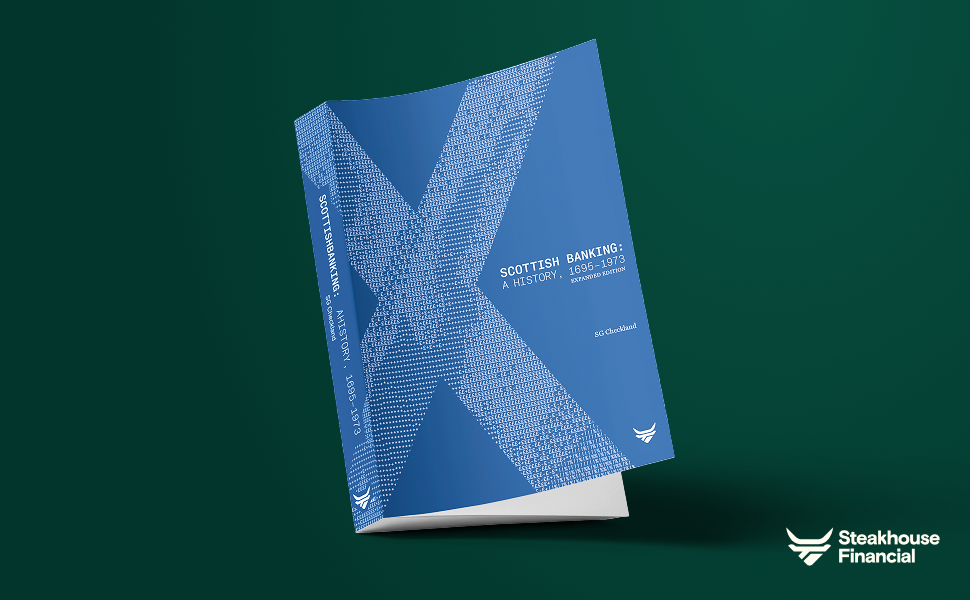
New foreword to the book, “Scottish Banking, A History: 1695-1973” by S.G. Checkland. One of the motivations for us to bring back this book to print was to celebrate the academic work of this great economic historian, whose detailed research and passion for the subject matter makes us daydream that he might have loved the crazy world of stablecoins as much as he was passionate for the universe of Scottish banking.
He was once the pin-up of British academe. Tall, handsome, with an unruly crest of brown hair, a beguiling Canadian accent and aromantic limp resulting from his war wounds. Renowned for his effortless way of pulling seemingly disparate strands together in one heady sweep; his verbal pyrotechnics, sending students and lecturers alike scrambling for the dictionary; his insouciant way of drawing diagrams on the rotating blackboard, then sending them spinning in one seamless action. An exotic and inspirational figure in the somewhat dour and parochial city of Glasgow of the 1960s and 1970s, where most students still lived at home.
His legacy? A shelf full of weighty tomes on such subjects as the Industrial Revolution, British public policy from 1776 to 1939, the Gladstone family, and the history of Scottish banking. The first served as the go-to textbook for a generation of students and the latter two earned him prizes, all now sadly gathering dust and cobwebs. Sic transit gloria mundi, one might think. However fine a contribution my father added to the sum of human knowledge, I assumed it was always doomed to be supplanted by the efforts of academics who came later.
How wrong I was.
In August 2024, I received a message on LinkedIn from someone called Adrian, introducing himself as an economic consultant specialising in cryptocurrency. He and his colleagues at Steakhouse Financial were ‘financial history geeks’, he explained, and as such were avid admirers of Dad’s history of Scottish banking, not just because it is a phenomenal work of scholarship but because they see many parallels between the swashbuckling adventures it relates and their own adventures in crypto. Might I, as literary executor, agree to them getting it back on the shelves in refreshed form?
What? Was this a prank? A ploy to part me from my money? Surely all financial wizards are interested in is getting rich quick. Full of scepticism, my partner, Jonathan, and I agreed to meet Adrian at Soho House in Chiswick for a drink.
Adrian turned out not only to be eminently presentable—think Clark Kent meets Harry Potter—but also sane and serious. Scottish banking has been like a Bible for him and his colleagues, he said, and although they knew nothing about publishing, they were more than ready to go through all the necessary hoops—and expense—of picture research, design and reprinting to bring it back to life.
Well, if you insist.
My dad was not just a pioneer of economic history during the post-war years but the architect of one of the most substantial and prestigious university departments on the subject. Since he retired in 1982, the subject’s star has fallen; it has since been integrated into general history or economics courses, mainly along econometric lines or the statistical analysis of data that already exists. Furthermore, as universities focus on survival, rattling the begging bowl for funding and enticing foreign students in for their money, primary research is taking a back seat.
Meanwhile, the internet, AI, and the misuse of these resources has scrambled our perception of reality and, indeed, our trust in truth. Interest in history has reached a nadir unknown since the Middle Ages, with vast swathes of the population content to live in a narcissistic present. When interest in the subject is shown, all too often it is to condemn the sins of our imperialistic fathers or to find ways of punishing them retrospectively. In his book The war against the past: why the West must fight for its history, Frank Furedi, professor emeritus of sociology at the University of Kent, writes, ‘Today’s presentist zeitgeist ... dispossesses the past of its claim to truth. At best, the past is indicted as irrelevant; at worst, it is charged with causing harm to the generations that have followed.’
Could it be that the books by my father and his generation, born of painstaking primary research, low tech, and a culture of knowledge for its own sake, are about to develop a new cachet? Could they soon be regarded as a gold standard, with more reprints in the pipeline? If so, the Steakhouse founders can add another innovation to their list of achievements.
Sydney George Checkland’s personal story, of rags to if not quite riches then at least writing about them, started out in 1916, in Ottawa, a lumber town comprising shabby clapboard dwellings, dirt roads and spittoons, with some pomp and ceremony attached, thanks to Queen Victoria having granted it capital status in 1857. Both Syd’s parents were émigrés from England, his mother a former matron in children’s homes, his father a colporteur, or door-to-door Bible salesman, desperate for better remuneration and fulfilment. Together they imbued their middle son with their own homesickness for the old country while making do in a cockroach-infested apartment above a grocer’s shop. Before long, Syd was struggling to reconcile his father’s rigid belief in the truth of the Bible with empirical fact as taught by his often-expat Scottish teachers.
Leaving school at 17, Syd got a job as a ledger clerk at the Bank of Nova Scotia, and his parents rejoiced: a respectable job for life, at £200 per annum! But Syd did the math, calculating that he would never save up enough to escape Hicksville. So he studied at night school with the Canadian Bankers Association, then took up a much-better-paid job as accountant to a Chinese laundry—only to discover that its finances were even more precarious than his own.
Time to rebel against his father’s puritanism and embrace Machiavelli’s tenet that the end justifies the means. Using cunning stratagems, such as sending out cheques in the wrong envelopes as a ruse to slow creditors down, by September 1938 he had not only transformed the laundry’s fortunes but saved himself £500, enough to pay his passage to England. His mother, now suffering from breast cancer, bravely waved him off, never to see him again.
Thus began a charmed period during which Dad worked his way through university as a labourer, met my mother, Olive Anthony—the girl with the honey-coloured hair and cracked glasses seated in the front row of the lecture theatre—and obtained a first-class honours Bachelor of Commerce degree. After that, a career in politics beckoned, and he was voted in as president of the National Union of Students, then president of the International Union of Students the following year.
In 1939, Syd bought himself a bike and set off on a 3,000-mile odyssey around the continent, learning to cycle as he went. In later years he would describe how, on disembarking at Cherbourg, he wobbled his way through streets lined with locals cheering uproariously at the sight of him; he had happened upon the route for the Tour de France. The adventure soured when he reached Freiburg, in Germany, where he witnessed a Nazi parade, complete with banners and shouts of ‘Heil Hitler’. It was clear that ‘this mad machine of intoxicated people who had shed their human identity’ needed to be stopped, as he wrote later in Voices across the water: an Anglo-Canadian boyhood.
Goodbye, International Union of Students, and hello, British Army, starting with six months of training at Sandhurst, the Royal Military Academy for officers in Berkshire, at the end of which he was awarded the Belt of Honour as the best cadet of his intake. He then switched to the Canadian army because it offered a better pension in the event of his injury or death, a pressing consideration now that he was married to Olive. This shift set in motion the events by which he would nearly lose his life.
The Canadian Governor General’s Foot Guards tank regiment was a return of sorts to Hicksville, fighting alongside the local lads from his childhood, who had nothing like his level of training. To make matters worse, when the orders came in June 1944 to cross the Channel, the American master of the merchant ship carrying Syd’s battalion failed to chain down the tanks properly, so that they shifted and suffered damage. Things got worse when they reached the Falaise pocket, where mayhem ensued, during which Dad’s tank was attacked by a camouflaged German Tiger tank, killing the wireless operator and setting the tank on fire. Pushing the dead man out, Syd ran for his life, sustaining extensive shrapnel wounds before plunging into a small haystack. There, after self-administering morphine, he spent the night before being found next morning by the unit’s padre. ‘The sense of relief was overwhelming’, he wrote in the memoir about his youth. ‘The fear, the nausea, the feeling of slipping away was replaced by a soaring determination to live. I would return to England, to wife and child, as yet unborn.’
Some of the greatest medical advances have been made during warfare, and my father was now a beneficiary of such experimentation. His right leg was basically shredded and under any other circumstances would have been amputated, but instead the medics propped the leg up behind him and encased him in plaster from his chest to his toes while giving him regular injections of the then-innovative penicillin, in the hope that the ‘cabling would grow back’, as he recalled later. After six months, he left hospital in calipers, categorised as 40% disabled but with two legs. Huge effort and application had him walking again, leaning on a stick and with a crippled right foot. My mother, now nursing my infant brother John, stepped up as chauffeuse.
Still determined to become a politician, he then stood as candidate for the Common Wealth Party in the general election of July 1945 for Ecclesall, Sheffield. This was a new socialist party founded by the writer JB Priestley and the Marxist historian Tom Wintringham, standing for common ownership, morality in politics and so-called vital democracy—a system of government in which state power would be vested in the general population. It is a testimony to Dad’s energy and charisma that he ended up with 14,000 votes to the 18,000 of the winning Conservative candidate.
He would stand once more for election, but due to his disabilities this ambition gradually gave way to the pull of academia. Back he went to Birmingham, and a master’s degree, followed by his first academic appointment in 1946 as an assistant lecturer in economic science at Liverpool, where he gained his PhD in urban and business history. Then onwards to a lectureship in history at Cambridge, followed, at the age of 41, by an invitation to set up a new chair of economic history at Glasgow.
Mum was reluctant, as she liked their life in Cambridge. But Dad, who recoiled from the snobbery and privilege of the dons, was thrilled not just at the prospect of being based in the proud mercantile, shipbuilding and industrial city but also at the potential for research, while the Scottish accent and humour offered a homecoming of sorts after his predominantly Scottish education in Ottawa. Founded in 1451, the fourth-oldest university in the UK, Glasgow was also no slouch in terms of longevity.
The move also meant that Dad could build his own empire. When he first arrived, Glasgow had just one lecturer in economic history who had been there since the 1920s. By the time he left, he had a staff of fourteen, including two professors.
He and Olive moved with us five children into the first of a succession of three grand houses owned by the university, Caerleon in Ledcameroch Crescent, Bearsden. It is around this time that my own memories begin, of a magical Dad who couldn’t have been further from the stereotype of the university professor.
Dad, stripped to the waist, looking every bit the lumberjack as he chopped down trees in our vast garden. Dad, mending engines with the help of refugees from the Hungarian uprising of 1956, whom he and Mum had put up in the old stables. Dad, chasing us around the house, brandishing his crippled foot, or letting me, aged 6, ‘drive’ the new family Zephyr. Making up stories about Ball Eye the Tiger, only allowing us an occasional glimpse of the eye to maintain suspense. Introducing me to Willie Snoop, the little man who lived in the muscle of his upper arm and jumped about when spoken to. Singing the popular, deliciously politically incorrect songs from his childhood: ‘Barney Google’ (‘with the goo-goo--googly eyes’), ‘Puddin’ Head Jones’ and the music hall song that goes ‘Oh, Mr Gallagher? Yes, Mr Shean. Do you think that handsome ladies have no brain?’
In 1962 we moved to Westdel, on Queen’s Place in Glasgow’s West End. Built in 1889 for the university’s publisher, Robert MacLehose, it contained a bedroom designed by someone called Charles Rennie Mackintosh, whom nobody we knew had heard of but who had been a brilliantly innovative architect inspired by the art coming out of Meiji Japan in the 1890s. Our bedroom was the first he produced in pure white, although Mum painted it a fashionable orange. In the late 1960s, Dad made the bedroom his own, so that when the BBC finally woke up to Mackintosh’s merits and made a documentary on him, Dad jokingly offered to pose in the bed while they filmed.
This was a time of drinks parties straight out of Kingsley Amis’s Lucky Jim, with Dad suave, Mum la-di-dah, me and my sisters distributing the nibbles. Visitors included Lord Reith, first director-general of the BBC and rector at the University of Glasgow from 1965 to 1968, at 6’6” towering over Dad by four inches, as well as the historian RH Tawney, who dropped his pipe tobacco all over the Parker Knoll armchair. By then, Dad was working on his Gladstone book, so the sitting-room carpet had to be cleared of the Gladstone family papers for these events.
Every summer my parents took the family on long camping trips, across Canada and the US or to Spain, Italy and Turkey. At the time, we groaned at the early rises and Mum’s insistence on driving 150 km before breakfast, but today we look back with nostalgia as well as awe. At Christmas, we threw Edwardian-style parties complete with charades and carols round the piano, with my mum belting out the tunes, as well as magic shows, the most memorable of which was when Dad sawed one of my sisters in half.
Other memories include table tennis championships, in which Dad rattled his bat up and down against the shelves like a hooligan, and visits by Japanese professors amid much bowing and smiling behind hands. Dad was among the first British historians to link up with Japanese academics studying the Samurai sons who came to Scotland in the 1900s to learn our technology. Ironically, the Scots were generous with their knowledge, it never having crossed their minds that these strange visitors would ever pose a commercial threat. After Dad’s death, my mother would write several books about the cultural links between Britain and Meiji Japan.
The family’s final move was to 5, The University, one of a row of massive granite houses designed by Sir George Gilbert Scott for the professors. This was the academic equivalent to living above the shop, and Dad was in his element, striding out to his department in the Adam Smith Building and the College Club opposite, a panelled establishment muggy with cigarette smoke and the smell of overboiled cabbage. Now that they had safely delivered all five children to university, Mum turned her energies to reading and commenting on Dad’s works, before gradually starting to write herself.
During this period Dad’s taste for politics had something of a renaissance, and he successfully led a campaign to create a separate Faculty of Social Sciences and penned a master plan outlining how the university might develop closer associations with the community; the ideals of the Common Wealth Party were still intact. During the student unrest of 1970, he figured out a nifty way of escaping his department from a side door and coming home for supper, leaving the students waving their banners in the belief that he was still trapped inside. While half the university considered him a ‘pinko’, he joked, the other half saw his views as ‘somewhere to the right of Genghis Khan’.
Curiously, considering his subject, Dad never had any personal interest in either money or possessions. He never carried cash, didn’t want to own property, and pretty much camped out wherever he lay his head.
By now, he was applying his knowledge of economic history to contemporary economic and social challenges, advising the development corporation for the East Kilbride new town and visiting the notorious gangster Jimmy Boyle in prison. He also wrote The upas tree, a history of Glasgow as a declining industrial city, using it as a paradigm for Britain as a whole. ‘In Checkland’, a reviewer from Scottish Economic and Social History noted, ‘past and future are brought together in a manner glimpsed by some of the great founding fathers of economic history in the later nineteenth century, yet so rarely achieved since.’ Meanwhile, he was the driving force behind the consolidation of the Business Archives Council of Scotland, dressing his staff in boiler suits and dispatching them out in lorries to collect records of failed businesses or ones that had been taken over, thereby saving whatever lessons they held for posterity.
Scottish banking was in many ways his most ambitious book. A mammoth enterprise, it spans the history of 100 businesses and was written with full access to abundant material in the relevant archives. The book covers not just the innovations of Scottish banking during its heyday—the replacement of ‘sterile coin’ with banknotes, the use of the limited liability principle as well as the overdraft facility—but the transformation of Scotland’s fortunes from a near-subsistence economy in 1700 to the forefront of the Industrial Revolution a century later, while presenting the stories of the men involved (yes, this is very much a ‘his’ story). Lastly, the book provides a summary of the theories thrown up by the great Scottish economists generated by this economic revolution: James Steuart, David Hume and Adam Smith.
Dad’s prestige and authority continued to grow right up to his retirement in 1982 and beyond. He was made chairman of the National Register of Archives for Scotland in 1971, Fellow of the British Academy in 1977, president of the Economic History Society from 1977 to 1980, chairman of the Industry and Employment Committee from 1982 to 1984, and honorary president of the Economic and Social History Society of Scotland in 1984.
Not bad for a boy from Hicksville, Dad.
London, UK
March 2026
Sarah Jane Checkland