

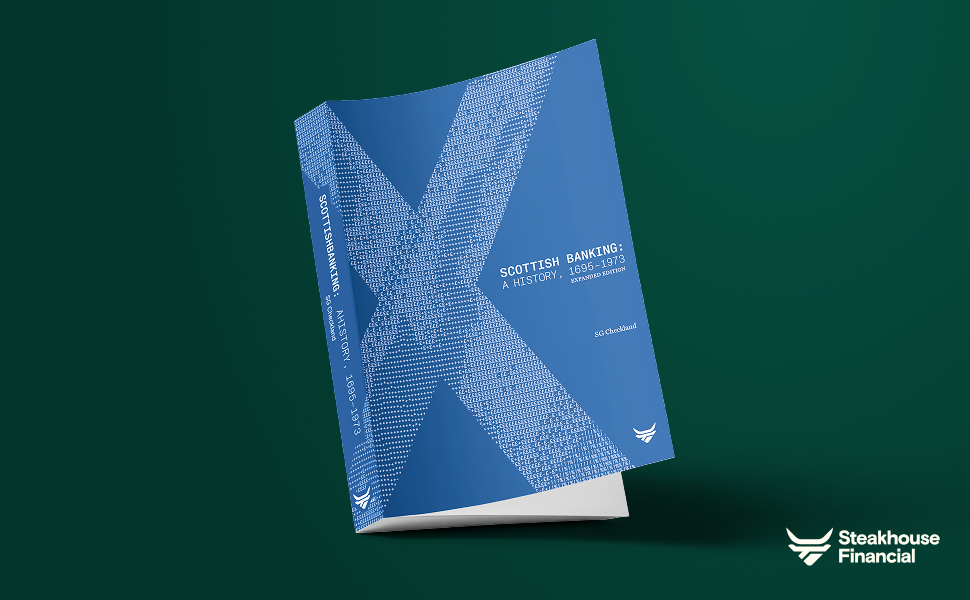
Steakhouse Financial Ltd’s origins as a company are rooted in the culture of the crypto industry. As co-founders, we met online as contributors to an open-source decentralized stablecoin project called MakerDAO (later renamed Sky, with a stablecoin, Dai, now known as USDS). Since then, we have helped other open-source projects and, increasingly, companies work out the structural economics of building successful open financial infrastructure. In particular, our work focuses on stablecoins, a burgeoning field of finance that looks a lot like many of the early historical attempts at banking.
Why is a company helping to build transparent finance with cryptocurrency interested in bringing back a book about the history of Scottish banking?
Firstly, because we are financial history nerds. We love reading about the men who figured out ways of doing things differently rather than following the script handed down to them by experts or elders. Scottish banking has been a central text in our obsession with well-researched records of how the modern financial system came to be. We like to think that SG Checkland would have been in his element following the development of the stablecoin industry and might have written a book about it too, in time.
Secondly, the similarities between the stablecoin industry and the early history of Scottish banking are remarkable. In Scotland, the emergence of privately issued liabilities provided a much-needed boost to a struggling rural economy, allowing enterprising Scotsmen to push into fields of trade such as tobacco or textiles. In stablecoins, the emergence of a reference asset that can be relied on to exchange value between two crypto addresses has allowed for a Cambrian explosion of experiments, ranging from remittance payments for the developing world and complex financial primitives all the way to scams and cons—not unlike the early Scottish banking sector, which spawned scoundrels such as John Law.
People may be familiar with how banks work, but what are stablecoins? These are private liabilities, redeemable on demand, issued either by a company or by an automated program running on a blockchain, that promise to track the value of a reference asset. In many respects, their balance sheets resemble that of early banks, such as the ones in this book. The openness of the public blockchains has enabled the efflorescence of countless stablecoins, in particular ones tracking the US dollar, and has produced a thriving competitive ecosystem that powerfully demonstrates the potential of building on crypto.
Like many transformational innovations, blockchains are, in themselves, quite simple, combining three previous discoveries in a novel way. The essential features of a blockchain are that it is (1) an accounting ledger, or database, (2) run in a cryptographically secure way across (3) a distributed network of computers. By ‘public’ blockchain, we mean open-source software that is entirely agnostic about who the user is and relies on automated economic mechanisms to ensure that the records in the database remain true. The chief value proposition of public blockchains, such as Bitcoin or Ethereum, is that they are decentralized (i.e. run by many people in a redundant way). This gives these data-bases important qualities, such as neutrality (no one party can decide who can write to the database) and resistance to censorship (anything is allowed to be written into the database).
Financially, this means that blockchain entries can be said to face no counterparty risk with regard to their validity. Counterparty risk materializes when one party in a transaction suffers a loss and value is lost to the other without warning. In 2008, many banks were exposed to profound levels of counterparty risk, when interbank trades related to one sector of the economy—meat-and-potatoes commercial banking—nearly collapsed as a result of cascading risk in an unrelated sector of the economy—residential real estate derivatives. Though counterparty risk still exists between parties that use blockchain-mediated exchanges, the public blockchain transactions themselves don’t face this issue, provided the blockchain itself is sufficiently decentralized. In this instance, the database entry cannot be reversed by any single
party. A source of truth is created. When an entry is written into a blockchain, it remains there forever, in full and public view. The blockchain itself is less a counterparty than shared infrastructure that anyone can use, like oxygen molecules or sunlight.
Scottish banks and stablecoins both evolved in an environment of cooperation between free and consenting individuals, with no government authority involved. Although the Act of Union allowed the Crown to retain some proscriptions regarding the use of private liabilities from the Bank of Scotland, Scottish banking differed from many other early reserve bank systems, including England’s, in its independence from the obligation to meet the government’s funding needs. It is easy to forget, but central banking is a very recent phenomenon in world history. The US Federal Reserve emerged in 1913 through a controversial public–private partnership, before ascending the ranks of administrative state power to its present commanding position over the world’s largest reserve currency. The Bank of England and the Bank of Amsterdam both had a unique sanction to provide for the funding needs of their respective governments and, in particular, to assist them with fundraising for wars and other projections of geopolitical power.
The Bank of Scotland, although incorporated by Act of the Scottish Parliament, had no such obligations, and as such a vibrant ecosystem of private banks was able to emerge, bringing with it competitive pressures, sly actions (such as accumulating competitor’s notes to threaten runs) and even banking services offered by merchant companies as a way of facilitating activities halfway around the world. We like to describe the issuance of stablecoins as ‘pure banking’. As Checkland puts in this book, ‘banking in Scotland was unique in its exclusive reliance upon the business opportunities afforded by agriculture, commerce and industry; it represented banking in its purest form’.
Other curious similarities exist between the Bank of Scotland and decentralized stablecoins, such as Sky’s USDS, that are issued by a program rather than a company. Use of the Sky program and its USDS stablecoin is unrestricted. Anyone can purchase a so-called governance token (named SKY) and participate in the process of setting the parameters for a balance sheet that, at time of writing, has over $10 billion in outstanding liabilities, or stablecoins. It is run as a DAO, or decentralized autonomous organization, which is a jargonistic way of saying ‘by vote’, regulated through preset rules encoded in programs that run on a public blockchain. Although the Bank of Scotland’s statutes aimed to restrict London’s influence by requiring that more than two-thirds of its shares be held in Scotland, in any other respect it was similarly an open corporation. As a public bank it could not restrict membership or expel shareholders, and shares were purchased on the open market. Curiously, the Act describes that ‘all Forraigners who shall joyne as Partners of the Bank shall be and become naturalised Scotsmen’. Similarly, all individuals who purchase a SKY token ‘shall joyne’ the DAO and become naturalized crypto swashbucklers.
Like Sky, which was originally set up with a public good in mind (global adoption of a common infrastructure, absent a central authority or administrator that might abuse its influence), the Bank of Scotland was, by implication, an institution built to further the public interest of Scottish citizens. Sky has not shareholders but token holders; the Bank of Scotland’s Act named its shareholders ‘adventurers’. Decisions on Sky’s parameters are determined by a token holder vote recorded on the blockchain, while the Bank of Scotland relied on general meetings of adventurers to perform acts such as naming directors, issuing more capital or paying dividends. In both instances, the balance sheets really filled up when depositors began relying on notes issued as trading instruments and units of account.
Stablecoins, like the free period of Scottish banking, demonstrate that individuals are capable of self-organising into functional units that unlock productivity and allow exchanges of property rights to occur. It is telling that this period of Scottish history also produced thinkers like Adam Smith, who defined the natural notion of a free market. To these thinkers, the modern reality of tightly regulated monopolies that privatise profits and socialise losses to a coerced and overtaxed citizenry would be the antithesis of what they set out to do hundreds of years ago. Stablecoins offer renewed promise for allowing people to make their own decisions and trade with one another without the need to rely on an over-bearing authority to orchestrate every exchange.
As one reads Scottish banking, two distinct eras emerge: before and after the Bank Charter Act 1844 and Bank Notes (Scotland) Act 1845. While competition and innovation was the key to commercial success in the period when banking was actually free, it became more oligopolistic (what Checkland calls ‘the cartel of the general managers’ committee’) and less innovative following the stringent over-regulation introduced by the Acts. The number of banks dwindled from seventeen in 1850 to eight in 1914, and established banks have since learned to use regulation to secure their rarefied positions. This was not without significance for the Scottish economy as a whole; the strength of its financial sector diminished as a result, especially compared to England. Crypto is currently sitting at the same critical juncture. Today, it is free and full of innovation and promise, but it is threatened by overzealous regulators champing at the bit to establish rules, pick winners and create monopolies.
Finally, this book is an authoritative, meticulously researched and timeless history that deserves to be resurrected in its own right. We are certainly motivated by our passion for stablecoins, crypto and financial history, and our desire to share it with a broader audience. It has been a delight to collaborate to that end with SG Checkland’s daughter, Sarah Jane, and her partner, Jonathan Margolis. But, ultimately, this work merits a return to the shelves simply because it is exceptional—an exquisitely detailed celebration of the entrepreneurial spirit of an indomitable nation that bequeathed the world an enlightened tradition of individual freedom.
George Town, Cayman Islands
March 2026
Mark Phillips, Sébastien Derivaux and Adrian Cachinero Vasiljevic
Steakhouse Financial Ltd