

By the 1770s, money meant metal. Across Europe and the trading world, value moved as gold and silver coin, and the few paper notes in circulation were claims on it, issued sparingly by a handful of state-chartered banks. However, not in Scotland. Silver and gold were slipping out of daily use, and a different kind of money was rising in their place: bank notes, issued by private banks that competed for customers, redeemable on demand, and trusted enough to pass from hand to hand as cash. Each note was the issuing bank’s own promise to pay, and Scots used them for everything. These notes would even occasionally ‘depeg’, or trade at a discount relative to their physical distance from the main branch.
As Adam Smith put it in 1776, ‘The business of the country is almost entirely carried on by means of the paper of those different banking companies. Silver very seldom appears and gold still seldomer’. In so largely dispensing with the precious metals, Scotland was unique.
If this private-money arrangement feels familiar, you’re not wrong. Two and a half centuries later the same thing is happening onchain, and most of finance still hasn’t noticed.
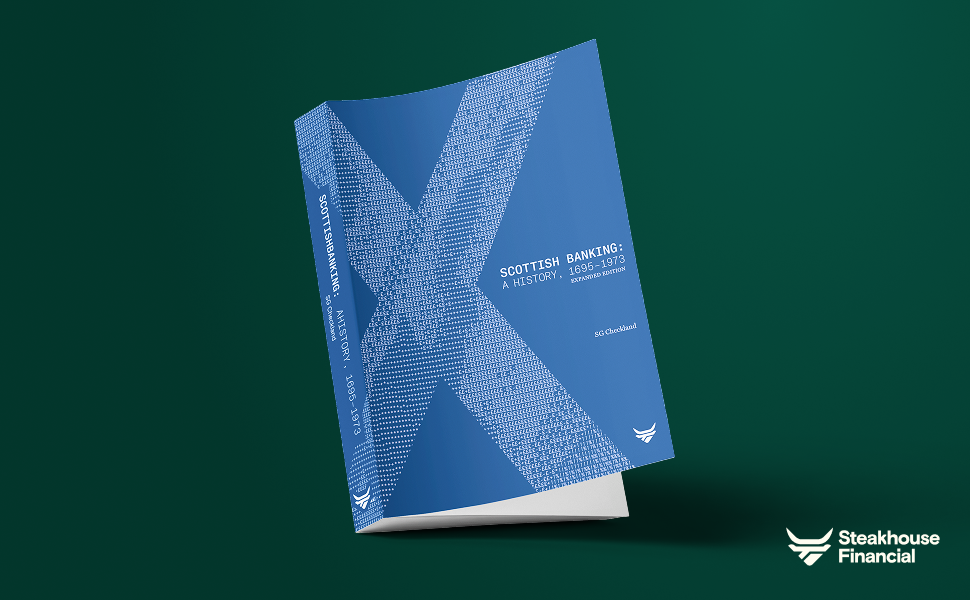
That is why we republished the book that documented one of the main instances where free banking thrived.
A market in money
Between 1695 and the middle of the next century, Scotland built a competitive market in money itself. Banks issued their own notes, redeemable on demand, and no central authority decided who could play. They learned as they went along: the cash credit, the first overdraft, arrived in 1728. The Bank of Scotland’s founding Act called its shareholders “adventurers” and even naturalized any foreigner who bought in.
The Scots wrote rules into the notes themselves. In 1730, tired of rivals collecting its notes and presenting them all at once to force a run, the Bank of Scotland printed an “optional clause” into its paper: the bank could redeem on demand, or defer payment for six months at interest, marking each note so the holder knew it was temporarily inconvertible and earning interest. A circuit breaker, written into the money.
Not every bank was so disciplined. In 1769 two dukes, two earls and some hundred and forty other landowners launched the Ayr Bank under the motto Pro Bono Publico, set on out-issuing everyone. It over-issued, lent loosely against land, and collapsed in 1772, taking most of the country’s private banks with it. Many of its backers learned only then that their liability was unlimited. Free money rewards discipline and punishes its absence, and Scotland ran the whole experiment of creative destruction, invention and wreckage both.
Today, we are building the same thing onchain, out of the same parts. Stablecoins are the redeemable notes. Onchain lending is the cash credit, now with a public ledger where a clerk used to sit. None of that is what decides whether it works. Scotland’s banks lasted a century and a half because most of them knew what stood behind their notes and issued no more than that. Ayr Bank was rare to ignore the rules and nearly took the rest down with it.
The whole thing turned on underwriting then, and still does.
Scottish Banking is back to the Future
Scottish Banking is the most complete record of that experiment in print. Checkland, a pioneer of postwar British economic history, spent his academic career on it and traced the whole arc across more than a hundred institutions: the inventions, the note wars between Edinburgh and Glasgow, the crises, the characters, and the legislation that ended the free period in 1844 and 1845, after which Scotland’s seventeen banks of 1850 became eight by 1914. The data is there in full, including the system’s slow run onto ever-thinner capital, from more than half the balance sheet to roughly 7%, each generation backstopped differently from the last.
Every argument onchain finance is having today, Scotland once had, with real money on the line. Who gets to issue money? What has to back a claim that’s redeemable on demand? What happens when everyone redeems at once? Does regulation keep the system open, or does the government appoint it to a licensed few?
Scotland answered all four, in order, over a century and a half.
Why we think in centuries
We republished it for a plain reason. We’ve used it as a reference point ever since we started contributing to MakerDAO years ago. It is the closest thing we have found to a field manual for what we do: underwrite private money and credit onchain, decide what backs a position, and judge how much room it has before something breaks. Checkland documented the first run of that experiment, start to finish. The second run is happening now. The book is the fastest way to see where it could go.
Scottish Banking: A History, 1695–1973, by SG Checkland, expanded with a new foreword from Steakhouse. On sale now.
Buy the book today from your preferred Amazon marketplace: https://www.amazon.com/dp/1036901750
Access the data and tables from the book: https://books.steakhouse.financial
Register for the book launch event in London on June 30, 2026, from 18:00 to 21:00.