


Welcome to another DeFi Markets Update—your no-nonsense briefing on the cryptobanking plumbing and market pulse.
Steakhouse Prime Onboards weETH After Protocol Hardening
Steakhouse worked with ether.fi over several months to harden weETH before adding it to Steakhouse Prime. The process covered governance changes, 13 protocol upgrades across five areas, and additional protections around oracle failure, withdrawals and slashing risk.
For weETH holders, the result is access to more capital-efficient stablecoin borrowing on Ethereum, with weETH/USDC and weETH/USDT now live at an 77% liquidation LTV (LLTV). Holders can keep their exposure to staked ETH while using weETH as collateral to borrow USDC or USDT.
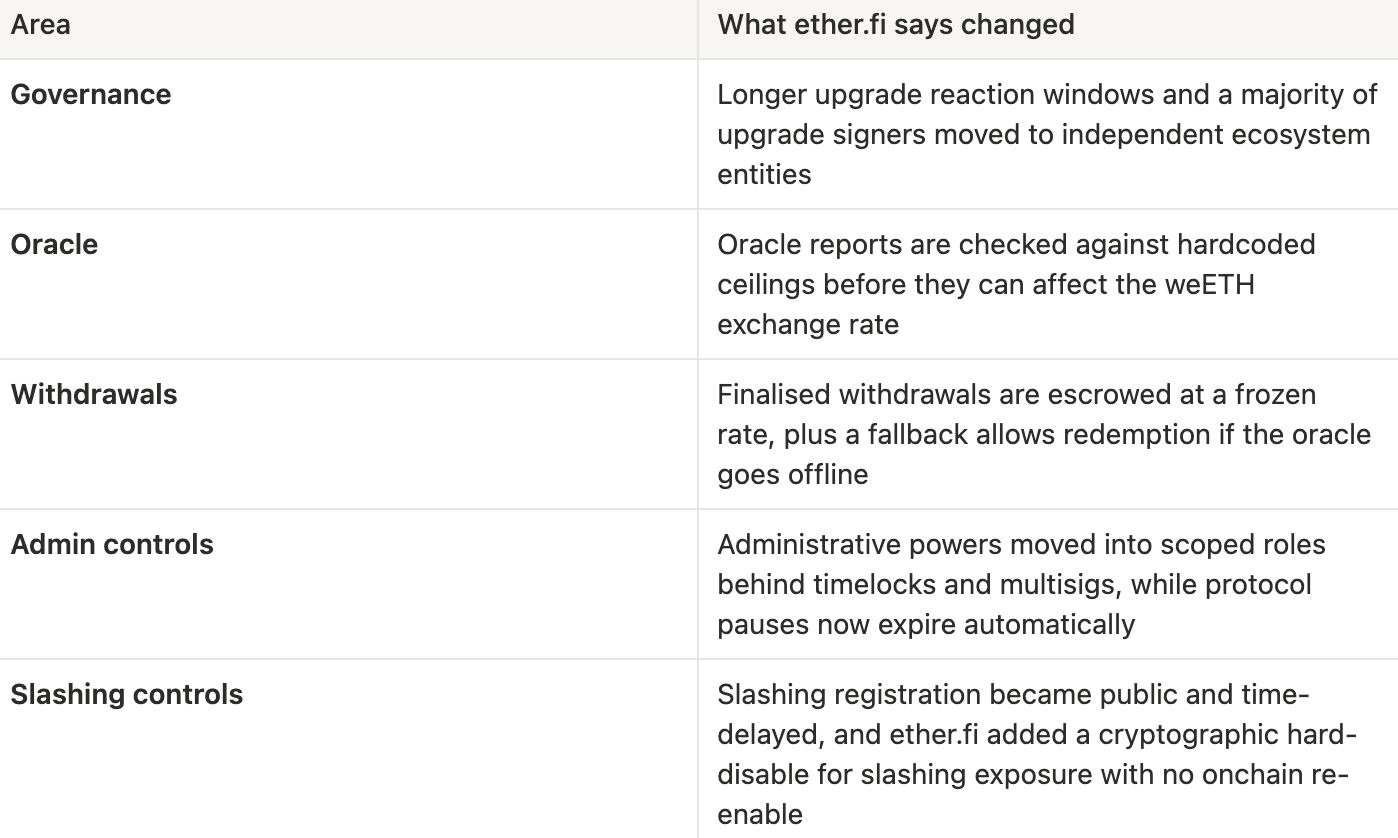
The Ethereum markets use Morpho’s overcollateralised lending model: borrowers deposit weETH and access stablecoins supplied by lenders. The new markets have an 86% maximum LLTV, meaning a position becomes eligible for liquidation when debt reaches that threshold relative to the value of its weETH collateral.
The weETH/USDC and weETH/USDT markets can be accessed through Steakhouse Prime strategies on Morpho Ethereum. Prime vault depositors provide stablecoin liquidity to eligible markets, while interest paid by weETH borrowers contributes to lender yield.
Grove Expands Across Governance, Credit and Liquidity
Grove Staking and Governance went live on August 4, giving GROVE holders direct control over protocol decisions through stGROVE. Holders can vote through Snapshot or delegate to one of three appointed delegates, with every staked token carrying voting power and a 2–4 week unstaking period helping keep governance stable during active votes.


The governance launch comes as Grove is also moving more of its institutional infrastructure into live use, with Grove Basin completing its first production transaction on July 28. A JTRSY redemption that would normally take several days delivered USDC immediately through Centrifuge, confirming that Basin can bridge the settlement delay in practice.
Basin extends Grove’s role from capital allocation into liquidity infrastructure for tokenized assets, with up to $1bn of committed daily liquidity available for supported transactions. This gives integrated platforms a way to provide immediate stablecoin liquidity while the underlying fund continues through its normal redemption and settlement process.
That liquidity layer sits alongside Grove’s growing role in credit creation through its $500m warehouse facility with Galaxy, which received its first $47.5m of funding in July. Grove now finances Galaxy’s origination of institutional BTC- and ETH-backed loans, building on its $50m allocation to Galaxy’s tokenized CLO in 2025, which provided exposure to loans after origination.
These developments show Grove expanding across the full lifecycle of institutional credit: governance controls protocol direction, Allocator deploys capital, the Galaxy facility funds new loan creation, and Basin provides liquidity around tokenized assets. This builds directly on Grove’s original goal of connecting onchain capital with institutional credit markets through a single infrastructure stack.
Examining the BIS Stablecoin Thesis Onchain
The Bank for International Settlements (BIS) recently published its 2026 Annual Economic Report, including a chapter on stablecoins and their potential role in the financial system. We analyse the main findings and compare them with what we are seeing across onchain credit markets.
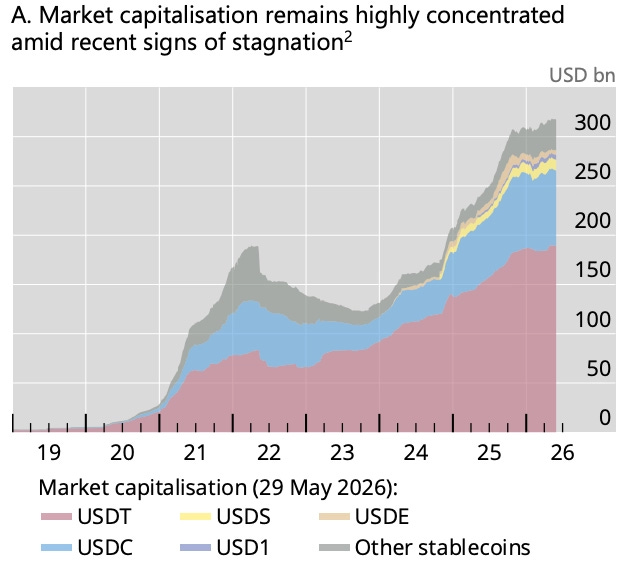
Stablecoins have scaled quickly, reaching around $320bn in market capitalisation by the end of May 2026. The market is still heavily concentrated in USDT and USDC, while 99.4% of fiat-backed stablecoins are USD-pegged; estimated stablecoin transaction volume reached $28tn in 2025.
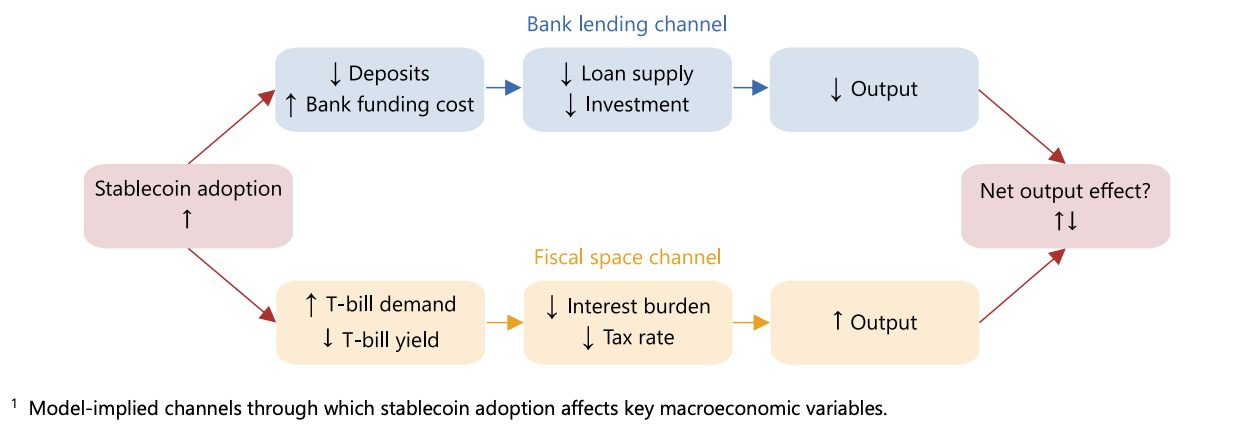
At larger adoption levels, the authors model how this growth could feed into traditional markets depending on where issuers hold their reserves. Stablecoin demand can raise bank funding costs and tighten credit supply, while issuer purchases of Treasury bills can increase demand for short-term government debt and reduce short-term sovereign funding costs
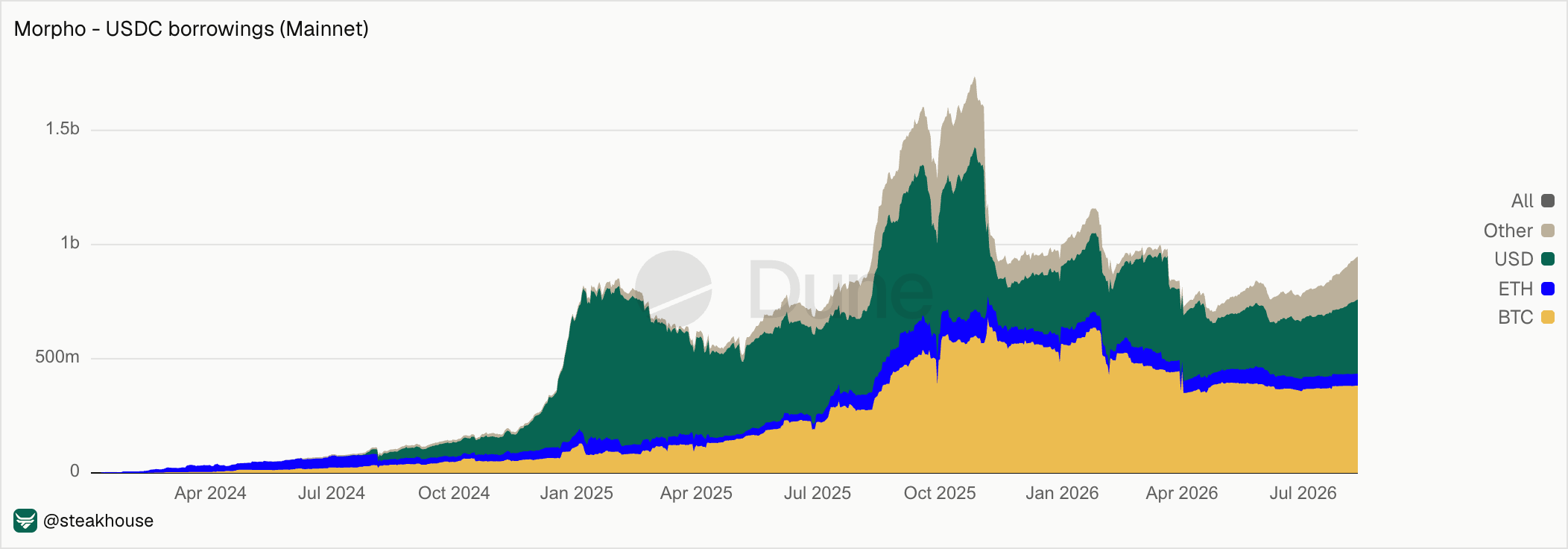
Morpho data shows that stablecoins are also being used at growing scale in onchain credit markets. Mainnet USDC borrowings grew from close to zero in early 2024 to more than $1.5bn at the 2025 peak, and have recovered toward $1bn in 2026; this represents predominantly crypto-native, overcollateralised credit.
The supply side of these credit markets has expanded as well, with Steakhouse-curated Morpho stablecoin vault TVL rising above $2.4bn across Ethereum, Base and newer networks. That is equivalent to roughly 0.75% of the $320bn global stablecoin market capitalisation cited by BIS, while Morpho overall holds around $4.4bn, or about 1.4% of the global stablecoin market, giving some sense of the scale onchain lending has reached relative to the broader stablecoin ecosystem.
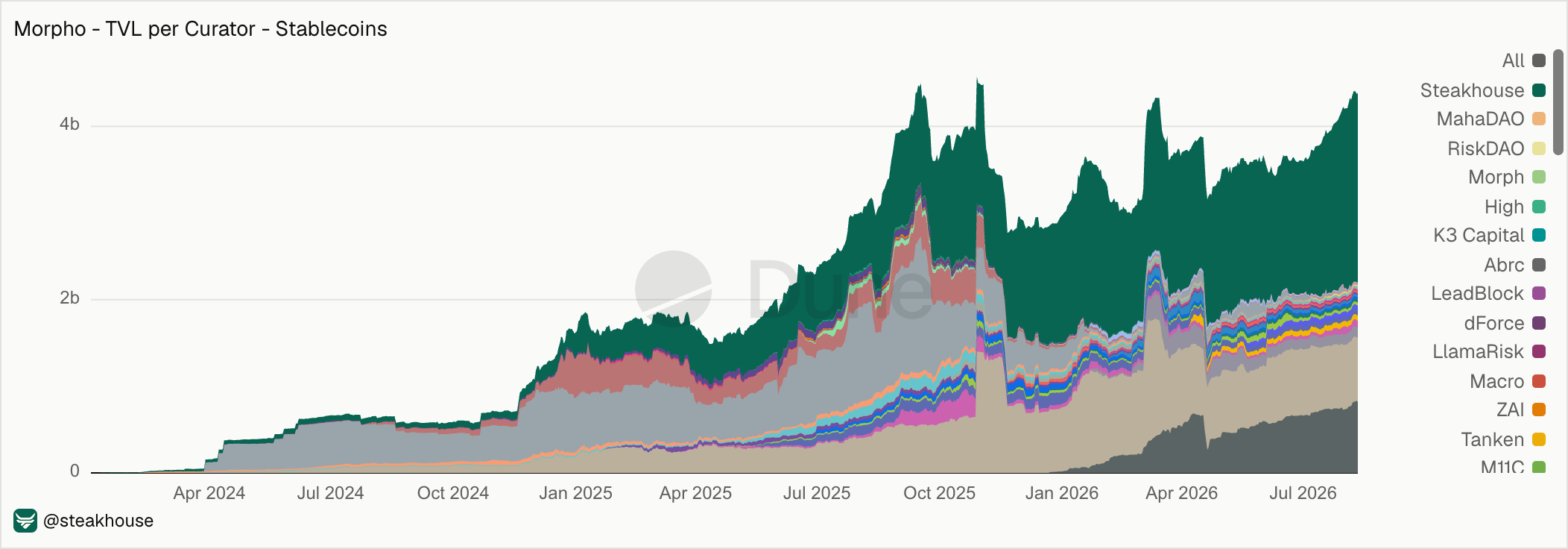
Together, the BIS analysis and onchain data show stablecoins becoming part of financial intermediation at two levels. Issuers channel reserve assets into markets such as Treasury bills, while stablecoin holders supply and borrow the circulating tokens through onchain credit markets; growing Morpho borrow balances and Steakhouse TVL show increasing activity on both sides of that second layer.