

Welcome to another DeFi Markets Update—your no-nonsense briefing on the cryptobanking plumbing and market pulse.
Steakhouse take on EthCC Cannes 2026
EthCC[9] took place in Cannes from March 30 to April 2, bringing together the Ethereum ecosystem for four days of conferences, workshops, and side events across the city. Our team was on the ground throughout the week, and we are grateful to everyone who spent time with us in Cannes. For those who were not there, this update gives a snapshot of the ideas, discussions, and market structure themes we brought to the Riviera.
Steakhouse chefs were active on stage during Cannes’ DeFi and stablecoin events. Alexis Bourdillat, our Head of DeFi Risk, joined the Vault Summit panel “Managing Vault Risk Through Market Stress”, which covered the biggest risks facing vaults today, how the industry can prevent failures and exploits, whether tokenised assets and RWAs introduce new risk layers into vaults, and much more. [to watch full discussion click here]
Our founder Sébastien Derivaux also spoke at Stable Summit Cannes in his presentation, “DeFi Architecture in 2026: Stablecoin, Vaults and RWA.” Stable Summit ran in Cannes as a dedicated forum for stablecoin infrastructure, liquidity, regulation, and market structure during EthCC week.
Sébastien framed DeFi in 2026 around three distinct building blocks: stablecoins as liabilities, vaults as the asset orchestration layer of DeFi, and RWAs as an onchain representation of offchain financial instruments. In his view, stablecoins are a bridge between the user world and DeFi, vaults sit inside DeFi as the asset side, and RWAs are a bridge between DeFi and TradFi.
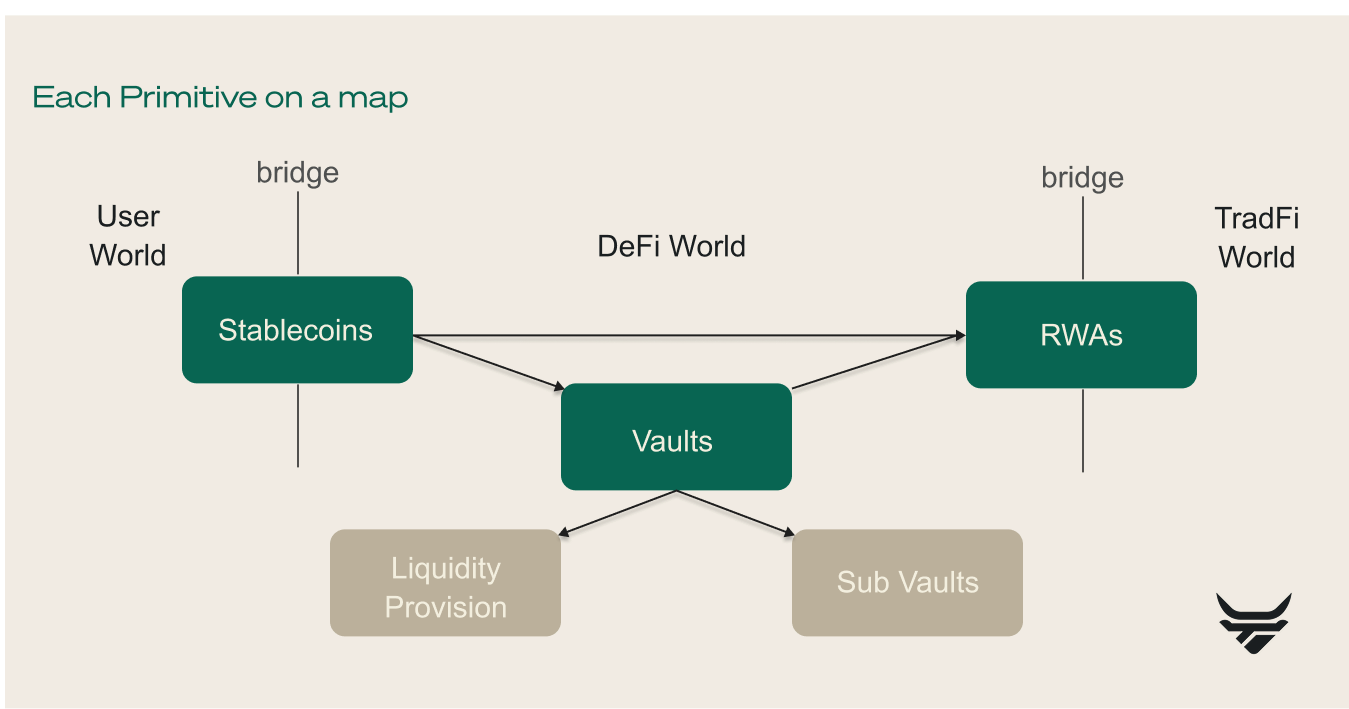
We can then apply that framework further. The example Sébastien used was Sky, where the stablecoin layer is focused on growing adoption of USDS while separate allocators such as Spark, Grove, and others handle the asset side. He also said vaults are still a bit too simplistic and can be used to grease the wheels of DeFi more effectively. The market has already tokenized the simplest assets, like money market funds or T-bills, and the most complex assets, like private credit, and the next area to build is the space in between. [watch full presentation here]
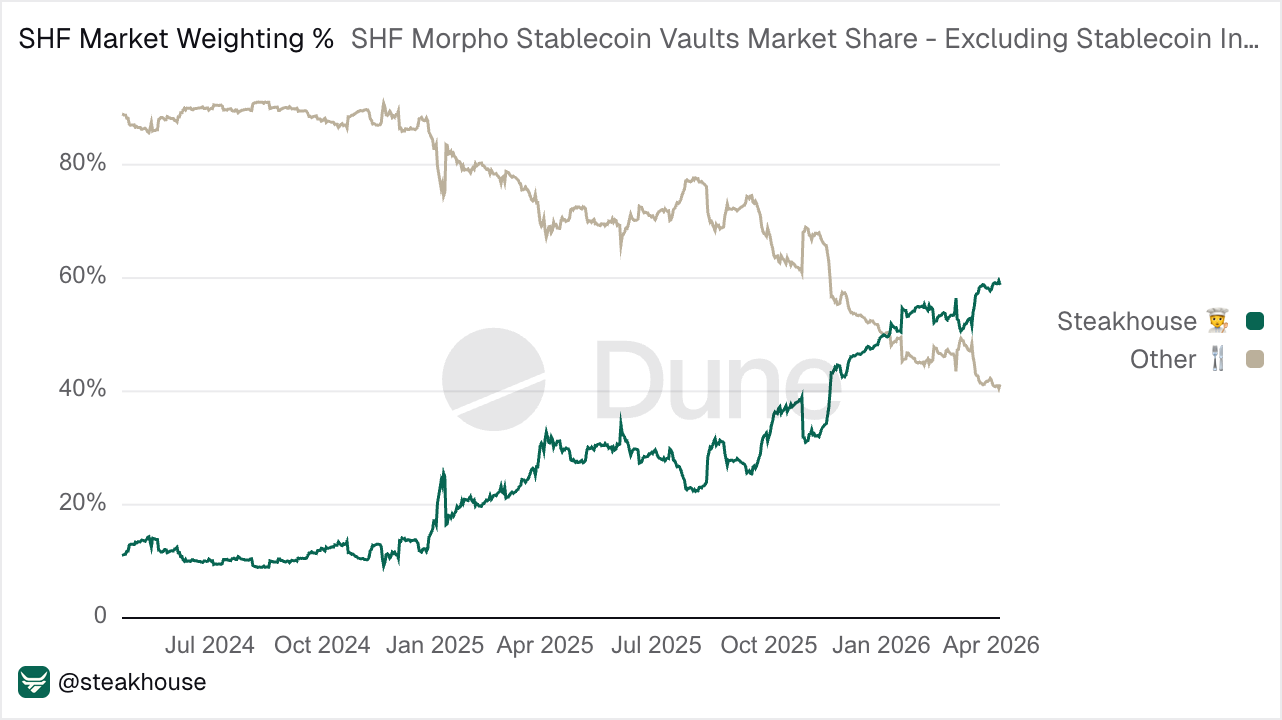
As DeFi moves toward this more modular structure, Steakhouse is already operating in that curator layer today as the largest curator on Morpho, managing 60% of Stablecoin Markets (excluding stablecoin farms).
Drift Exploit Recap
DeFi recorded its largest exploit of 2026 on 1 April, when Drift lost about $285m of user assets in a governance compromise that executed in minutes after months of prior social engineering. Drift’s own investigation says the attackers spent roughly six months building relationships with contributors, posed as a quantitative trading firm, onboarded an Ecosystem Vault, deposited over $1m, and used that access to stage the exploit.

The exploit path combined compromised signer workflows, durable nonce transactions, fake collateral and oracle control. The attacker used pre signed approvals to seize admin control of Drift’s zero timelock 2 of 5 Squads governance, listed a fake token market, set an attacker controlled oracle, lowered withdrawal protections and completed 31 withdrawals in about 12 minutes.
The stolen funds remain visible onchain. Arkham’s Drift Protocol Exploiter page tracks the labelled exploiter entity and lets users follow linked wallets, holdings, inflows, outflows and counterparties across chains as the funds move.
The impact was immediate as Solana TVL fell by $1bn over the following day, Drift’s TVL alone dropped from roughly $550m to under $250m, and SOL traded down by circa 10%. Hence, this being the largest DeFi hack of 2026 so far and the second largest security incident in the Solana ecosystem after the $326m Wormhole exploit in 2022.
When one large venue breaks, the shock is able to travels through vaults, structured products and credit pools that source yield from the same underlying markets, so users can feel losses one or two layers away from the original exploit, and unfortunately Drift’s 28k token holders on Solscan show how widely that risk can sit.
Steakhouse had zero exposure to Drift. To safeguard against liquidity drawdowns, we temporarily reduced exposure to the JLP Market on Kamino and SOL positions on Base and Monad, and communicated those position changes to our users through updates on X.


Solana is a space we entered to build non custodial, transparent internet capital markets beyond EVM, and we are committed to keep building there. No matter the setback, DeFi always comes swinging back, and Steakhouse is here for it.
How and Why to Migrate to Morpho V2
Morpho Vaults V2 launched in late 2025 as a full vault architecture upgrade, bringing stronger governance, clearer role separation, immutable contracts, and a flexible adapter system that supports strategies V1 could not support.
Steakhouse users with V1 positions can migrate into equivalent V2 vaults with similar risk-return profiles, including Steakhouse Box Vaults for Term and Turbo on the Steakhouse App.
For Steakhouse users, the key V2 improvements are broader strategy support through adapters, timelocked governance that gives depositors visibility before risk-increasing changes execute, and abdication features that let curators lock in permissionless access and fixed strategy scope at the contract level.
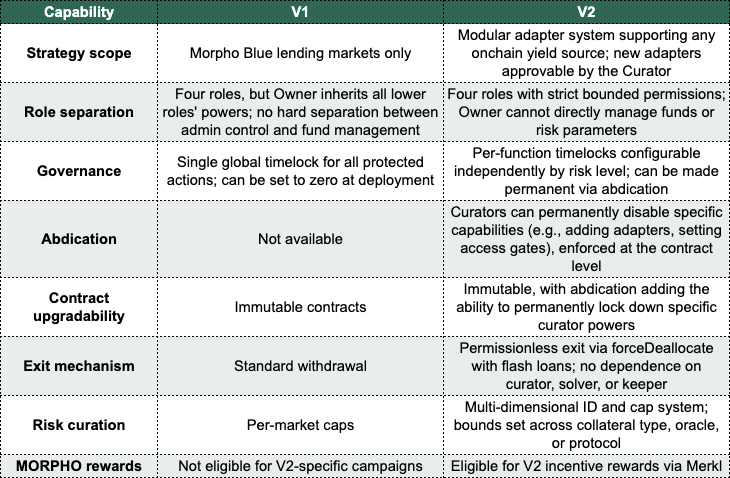
In December 2025, Morpho DAO approved MIP 124, which increased the MORPHO rewards budget by 14% for a V2-specific incentive campaign, with rewards distributed through Merkl and updating every eight hours, which gives V2 depositors an APY uplift on top of base lending yields, while V1 positions are outside that programme.
The migration path is available through the Steakhouse App in one transaction: connect your wallet, go to the Earn page, find vaults marked with an Upgrade indicator, review the side by side comparison between your V1 position and the V2 equivalent, and confirm the upgrade while keeping funds under your control throughout the process.
V1 vaults remain functional and withdrawals remain available, but new deposits will close on V1 vaults that have a V2 equivalent, so liquidity can consolidate where governance, infrastructure, and incentive rewards are strongest; we have published the full detailed V2 Migration post on Substack for anyone who wants the complete breakdown.