

Welcome to another DeFi Markets Update—your no-nonsense briefing on the cryptobanking plumbing and market pulse.
Capital Allocation in an Increasingly Curated DeFi Credit Market
In the paper ‘Institutionalizing Risk Curation in Decentralized Credit’, posted on arXiv, the authors argue that underwriting in DeFi has moved from the protocol governance layer to the curator layer. Their point is that protocols such as Morpho and Aave are better understood as infrastructure, while curators are increasingly the ones deciding asset selection, leverage bounds, and portfolio construction. However, note that the dataset used in the paper ends in early November 2025.
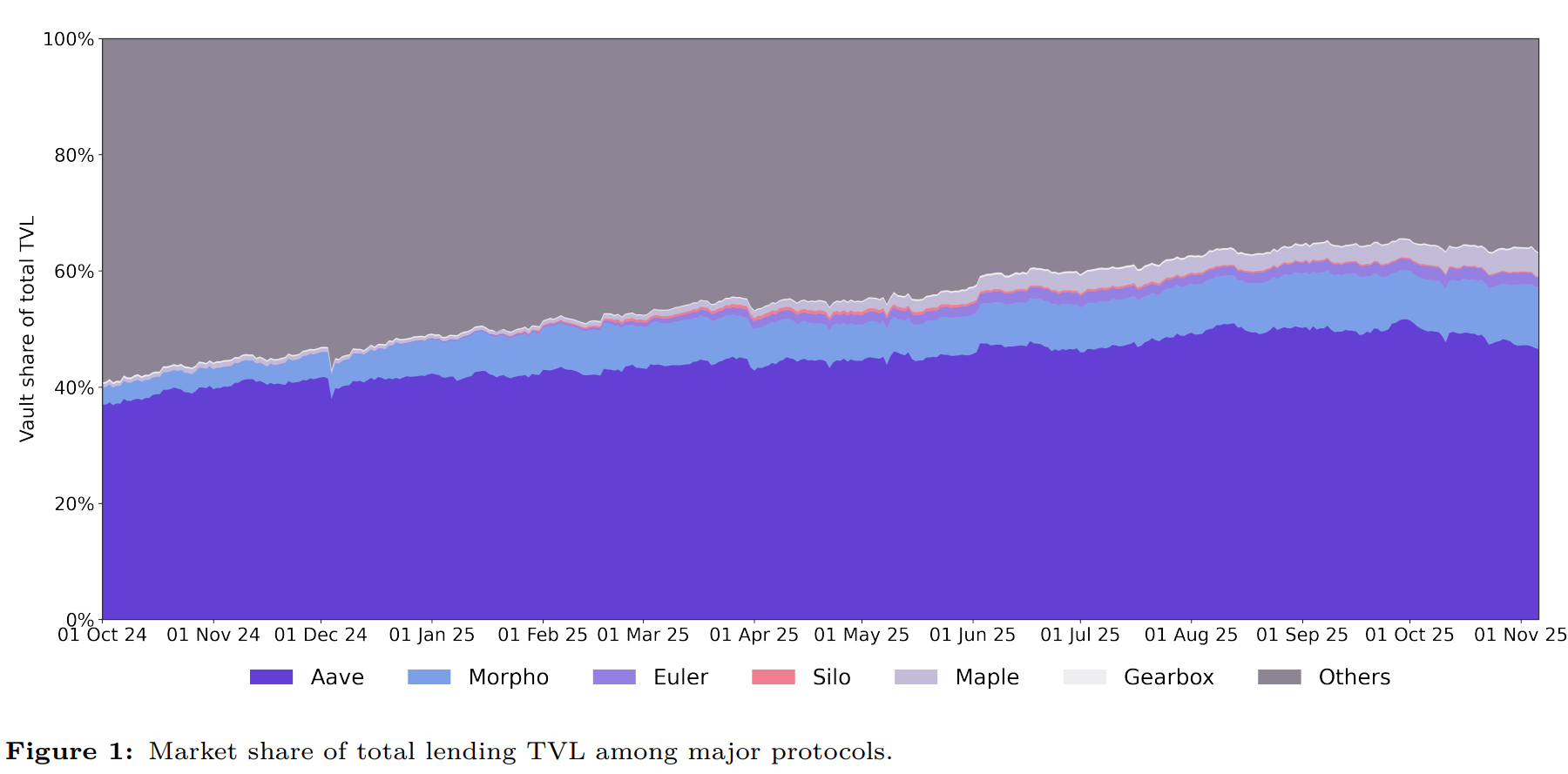
The paper also argues that major lending protocols are converging. By mid-2025, the authors find that large lending systems were increasingly moving in sync across collateral mix, chain expansion, and liquidity conditions, which weakens the case that simply spreading capital across protocols is still meaningful diversification.
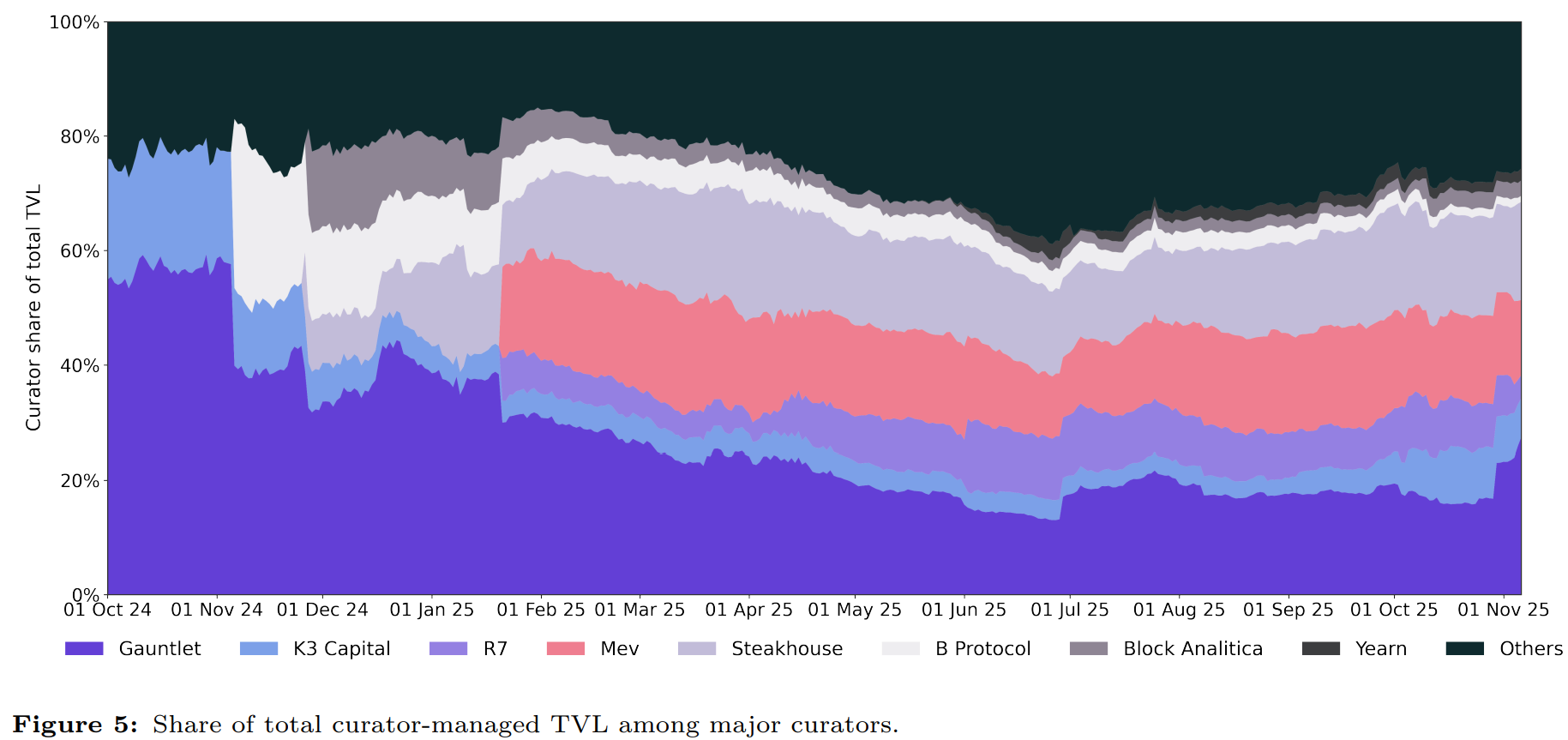
In November 2025, the top four curators(Steakhouse, Gauntlet, MEV Capital, and K3 Capital) controlled around 65% of curated TVL. But curators do not take the same kind of risk, and today only Steakhouse and Gauntlet remain at the top. The authors shows differences in volatile exposure and portfolio concentration across curators, which suggests users are no longer just choosing a venue, but also choosing a risk profile.
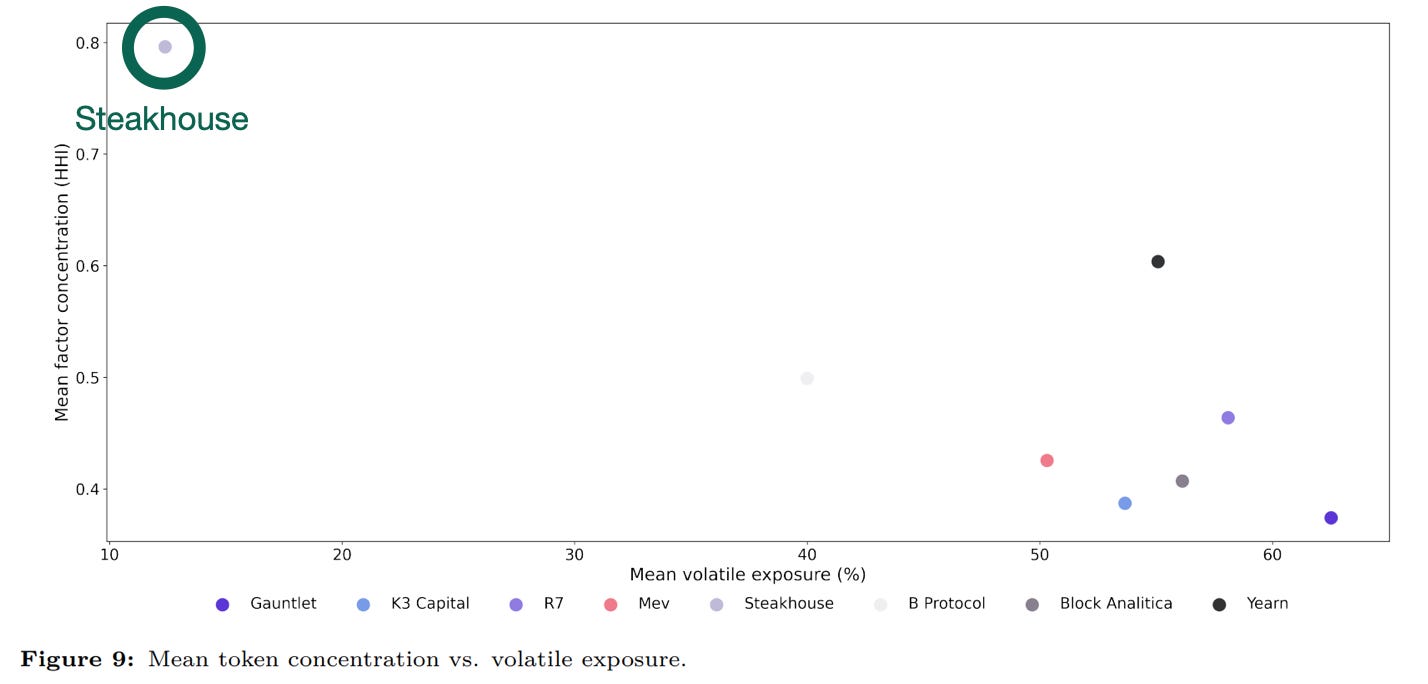
The article focuses on the share of stable versus volatile assets used in vaults. Steakhouse’s focus and expertise have always been in stablecoins, which keeps it relatively small in the volatile bucket. The authors note that Steakhouse’s positioning is “akin to a large money-market or government-bill fund,” which is indeed our objective.
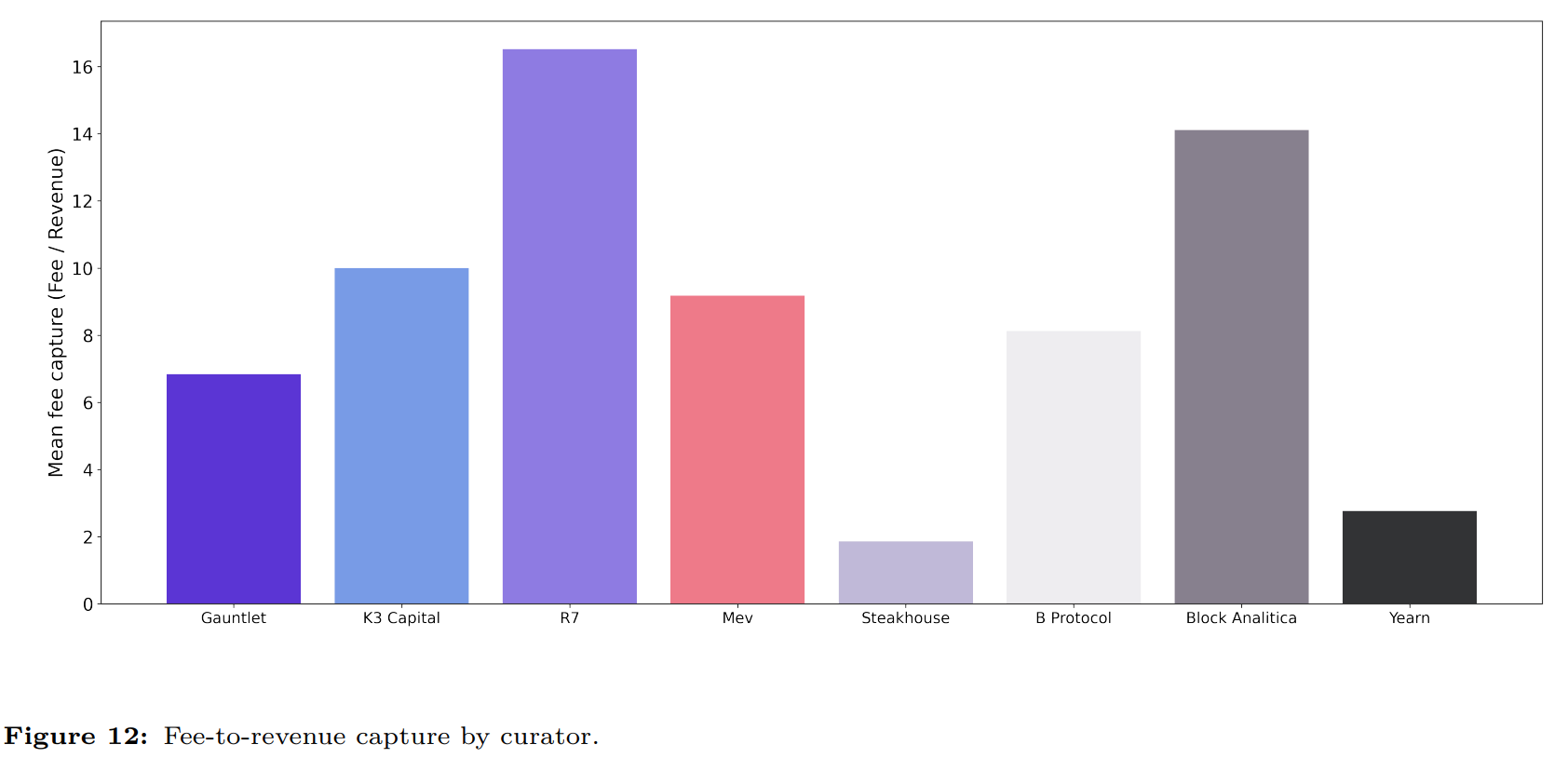
Moreover, curators also differ in how much of the yield they retain. The paper shows that “Re7 and MEV Capital explicitly run more active, higher-beta strategies, so higher fee shares can be justified by higher gross yields” (both have since been hit by Stream Finance), while Steakhouse keeps less than 3%, pointing to two distinct models: one that charges more in exchange for more active risk-taking, and one that relies on scale, lower fees, and depositor confidence.
Overall, the paper shows some interesting data points, and the next step is to dig deeper into the actual risk profile of the underlying collateral. The important question going forward is which exposures sit inside each vault and how they behave under stress, which is the direction we are taking with our own Vault Ratings in the new Steakhouse App.
USDC Yield is Becoming Easier to Access
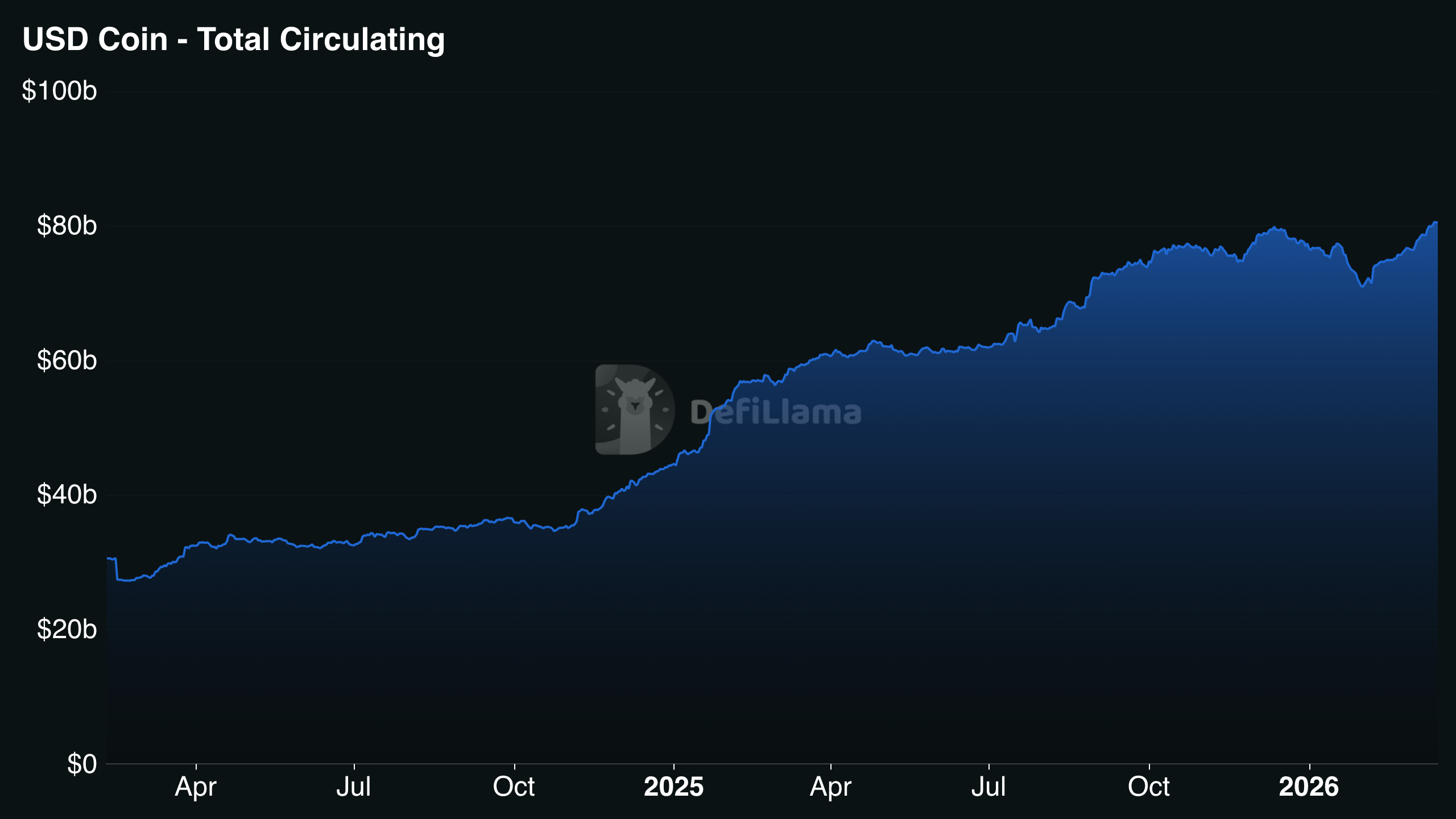
USDC has crossed the $80bn mark in circulating supply, including unreleased supply. The total stablecoin sector is around $315bn, therefore, USDC now makes up roughly 25% of the whole stablecoin market.
Crypto markets have felt increasingly unsettled since the start of 2026, and in this kind of environment, one of the simplest positions can still be one of the best: holding stablecoins that stay liquid while earning yield on them.
Ramp users can now do this directly in-app. Steakhouse curates the strategy and risk parameters behind Ramp Earn, Ramp’s new in-app USDC yield feature. Users can deposit USDC directly in the wallet and earn variable yield through Morpho, with no fees and no lock-up.


Another example is QiDao’s Goldbot Sachs product, which applies the same idea to AI-agent wallets. Users can deposit USDC into clawUSDC, a Base ERC-4626 vault designed for idle balances sitting inside agent-controlled wallets. The current setup routes funds through a Beefy strategy connected to Morpho, with Steakhouse curating the underlying USDC strategy.

Across Ramp and QiDao, users can now access roughly 3–7% variable yield on USDC strategies curated by Steakhouse, without needing to interact with the underlying lending stack directly.
Elevated Yields Across Steakhouse Vaults
On Ethereum, Steakhouse High Yield USDC currently offers the highest APY among the selected competing USDC vaults shown below.
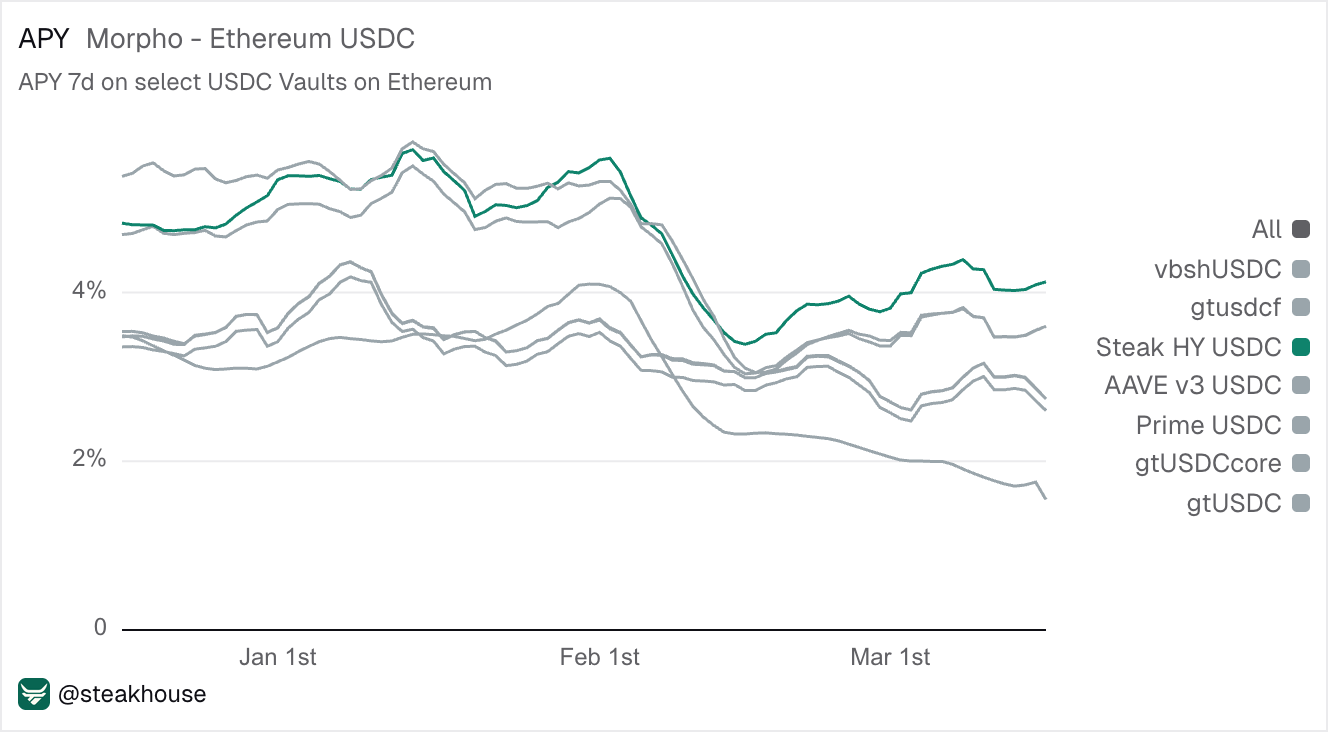
The High Yield vault allocates across a broader collateral mix, led by siUSD and mF-ONE. siUSD adds liquid, yield-bearing stablecoin exposure, while mF-ONE provides tokenised exposure to Fasanara’s multi-strategy private credit platform. With mF-ONE yielding around 10% APY in recent weeks, this mix has helped the High Yield USDC vault sustain higher yields than our competitors.
Steakhouse continues to offer solid USDC rates across multiple chains, with HY USDC on Katana at 9.12% APY, HY Instant on Mainnet at 5.29%, and HY USDC on Monad at 4.89%.

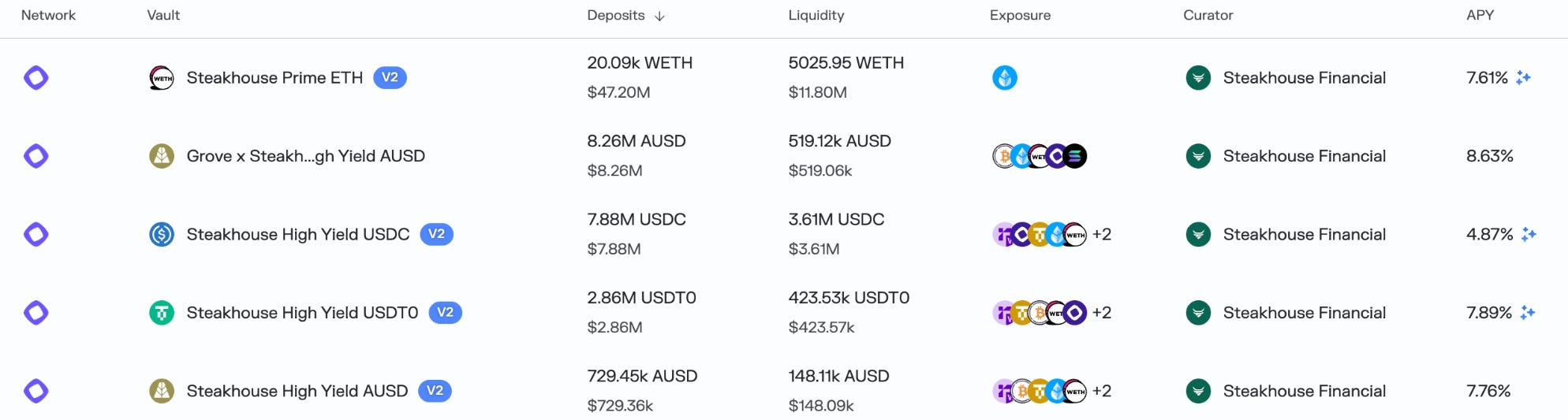
Furthermore, yields on Monad remain elevated across several Steakhouse vaults. For example, Grove x Steakhouse HY AUSD is now earning an organic 8.6% APY as Grove reduces its AUSD exposure on Monad and shifts more allocation toward Ethereum.
Incentivised vaults like Prime ETH, HY USDT0, and HY AUSD are all above 7.5% APY.
We also launched a new cbBTC vault on Monad, which is currently earning 3.6% APY.
